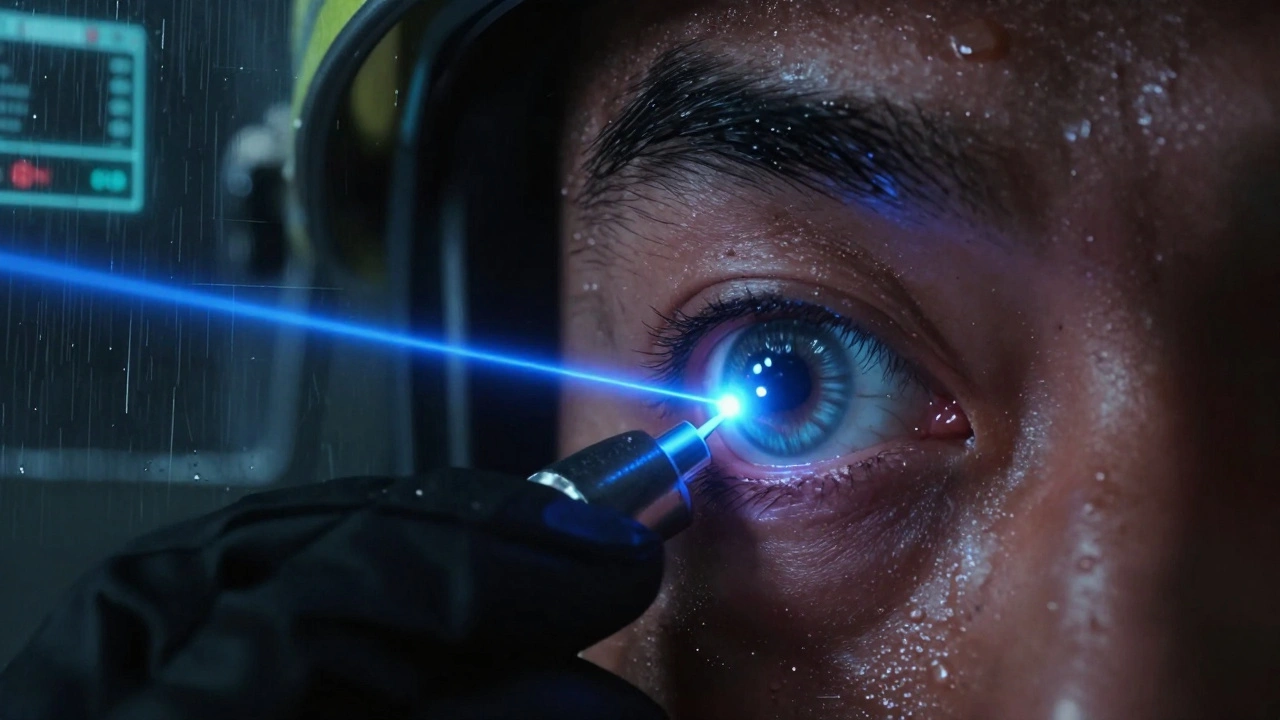
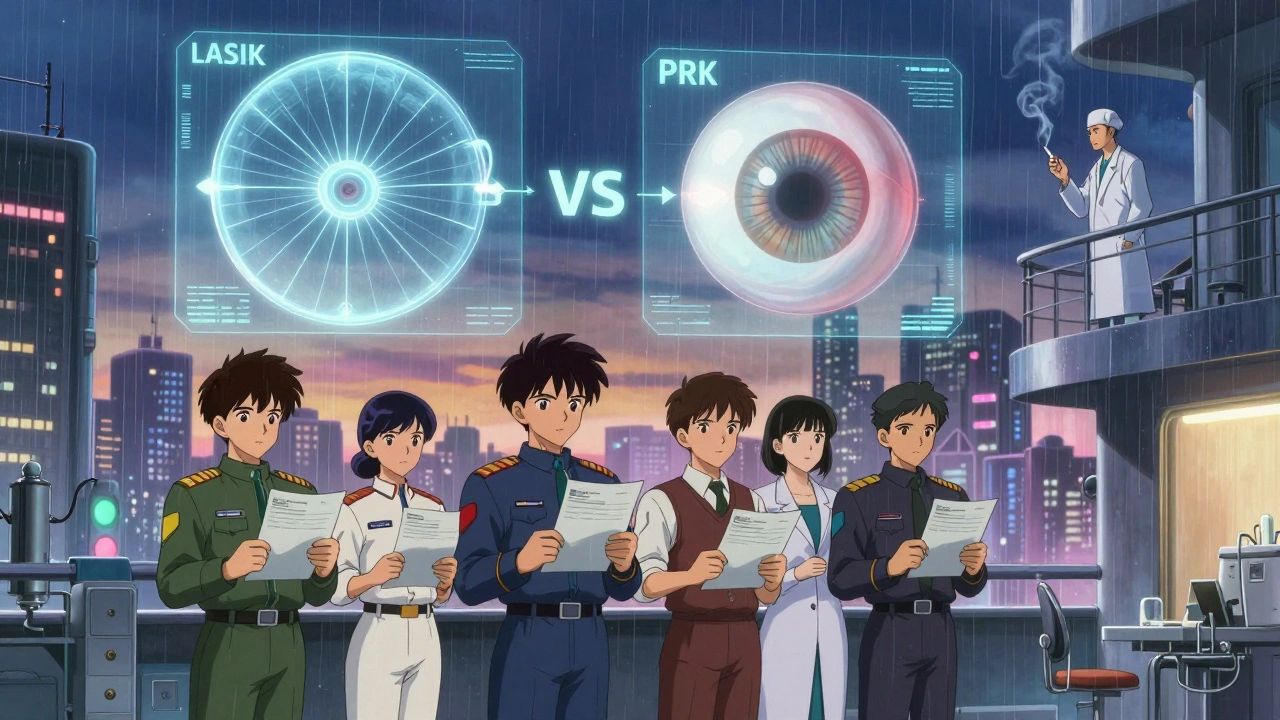
When you’re tired of glasses or contacts, laser eye surgery sounds like a dream. But with two main options-LASIK and PRK-it’s easy to get stuck. Both fix nearsightedness, farsightedness, and astigmatism. Both use the same laser to reshape your cornea. And both give you 20/20 vision or better in over 90% of cases. So why does one cost more? Why does one take weeks to recover? And why do firefighters and Marines pick one over the other?
How LASIK Works-The Flap Method
LASIK starts with a thin flap. A laser cuts a small, hinged layer on the surface of your cornea, just big enough to lift up. Then, another laser zaps the tissue underneath to change its shape so light focuses correctly on your retina. The flap is folded back down. No stitches. It sticks on its own.
This two-laser system-first the flap, then the correction-is what makes LASIK faster. Most people see clearly within 24 hours. Many drive the next day. By day three, most are back to normal activities. That’s why it’s the most popular choice in the U.S., making up 650,000 of the 700,000 laser eye surgeries done each year.
But there’s a catch. That flap, while strong, can be a risk. If you get hit in the eye-say, during a basketball game or a fall-it could lift or shift. That’s rare, but it happens. About 0.8% of LASIK patients deal with flap-related issues like epithelial ingrowth or dislocation, according to the Journal of Refractive Surgery.
How PRK Works-The Surface Approach
PRK doesn’t make a flap. Instead, it removes the entire outer layer of the cornea-the epithelium-using alcohol, a brush, or the laser itself. Then it reshapes the cornea underneath, just like LASIK. The epithelium grows back naturally over the next few days.
This sounds simpler, and it is, technically. But recovery? That’s where it gets tough. For the first 3 to 7 days, your vision is blurry. Your eye feels raw. You’ll wear a soft bandage contact lens to protect it. Light hurts. You can’t drive. You’ll need to take it easy.
It takes weeks to see clearly. Full results? That can take 3 to 6 months. But here’s the upside: no flap means no flap complications. That’s why PRK is the go-to for military pilots, boxers, and firefighters. If your job puts your eyes at risk, PRK is the safer long-term bet.
Who’s a Better Fit for PRK?
Not everyone can get LASIK. Your cornea needs to be thick enough to safely create a flap. Most surgeons require at least 500 microns of thickness. If you’re thin-corneal-common in people with high prescriptions-you might not qualify.
PRK doesn’t need a flap, so it’s perfect for those with thinner corneas. It’s also better if you have dry eyes. LASIK can make dryness worse because it cuts nerves in the cornea during flap creation. PRK doesn’t do that, so long-term dry eye is less common.
About 15% to 20% of people who want laser surgery are better suited for PRK. That’s not a small group. If you’ve been told LASIK isn’t for you, PRK might still be an option.
Recovery Time: Hours vs. Weeks
Let’s get real about recovery. If you’re a teacher, a programmer, or a parent who can’t afford to be blind for a week, LASIK wins. You wake up the next day with clear vision. You’re back at your desk. You’re watching your kid’s soccer game. No disruption.
PRK is the opposite. You need to plan for downtime. Days 1-3 are the worst. You’ll need someone to drive you home. You’ll need to avoid screens, bright lights, and anything that strains your eyes. You’ll be on antibiotic and steroid drops for weeks. You can’t swim, sweat heavily, or wear eye makeup for at least a month.
But here’s what most people don’t say: the long-term comfort of PRK often beats LASIK. After six months, PRK patients report fewer dry eye symptoms. Their corneas heal more naturally. One Reddit user, a firefighter who had PRK in January 2022, wrote: “Days 1-3 were awful. But by week 4, my vision was 20/15. I’d do it again in a heartbeat.”

Cost Difference: What You Pay Now
LASIK costs more. A lot more. In 2023, the average price in the U.S. was $2,600 per eye for LASIK and $2,200 for PRK. That’s a $400 difference per eye. For both eyes? That’s $800.
Why? LASIK uses two lasers. PRK uses one. The extra tech adds cost. In big cities like New York or San Francisco, prices can be 25% higher. But even then, PRK is cheaper.
Insurance rarely covers either. Only 12% of U.S. plans pay for any part of laser eye surgery-and mostly for military personnel. For most people, it’s out-of-pocket. So if you’re budget-conscious and your eyes qualify, PRK saves money without sacrificing results.
Long-Term Results: Same Vision, Different Path
Here’s the big truth: after one year, there’s no difference in vision quality between LASIK and PRK. Studies show both give you the same sharpness, clarity, and stability. At 10 years? Still the same. At 20 years? Still the same.
Dr. Robert Steinert, a former chair of ophthalmology at the University of Washington, said it plainly: “The 20-year data shows both procedures are stable, predictable, and safe.”
The only real difference is in side effects. LASIK has a slightly higher chance of temporary dry eyes. PRK has a small risk of corneal haze during healing-usually mild and fades with time. Both complications happen in less than 1% of cases when done by experienced surgeons.
Who Should Choose LASIK?
- You need to get back to work or school fast
- Your cornea is thick enough (500+ microns)
- You don’t play contact sports or do high-risk jobs
- You’re okay paying more for speed
- You’re in your late 20s to early 40s-the most common age group for LASIK
LASIK is the default choice for most people. It’s fast, reliable, and has a 96% satisfaction rate across 127,000 reviews on RealSelf. If your life moves quickly, and your eyes are healthy, LASIK gives you freedom in days, not months.
Who Should Choose PRK?
- Your cornea is too thin for LASIK
- You have chronic dry eyes
- You’re in the military, law enforcement, or contact sports
- You’re willing to wait for better long-term comfort
- You want to save $800 on both eyes
PRK isn’t a second choice. It’s the right choice for many. The U.S. military expanded PRK coverage to 100% of service members in 2024 because it’s safer for active duty. If your job puts your eyes at risk, PRK isn’t just smart-it’s essential.
What Happens Before Surgery?
You can’t just walk in and get operated on. First, you need a full eye exam. This includes:
- Corneal topography-maps the shape of your cornea
- Pachymetry-measures corneal thickness
- Dry eye test-checks tear production
If you wear contacts, you must stop. Soft lenses? Stop for 1-2 weeks. Rigid gas permeable lenses? Stop for 4 weeks. Your cornea needs to return to its natural shape before surgery. Skipping this step can mess up the results.
What Happens After Surgery?
LASIK aftercare is simple: no rubbing your eyes, no swimming for two weeks, and a few days of lubricating drops. Most people need just one follow-up visit.
PRK aftercare is more involved. You’ll need:
- 5-7 days of rest
- Bandage contact lens for the first week
- Antibiotic and steroid eye drops for up to 3 months
- Regular check-ins with your doctor for the first month
It’s more work, but it’s worth it if you’re a candidate. The key is patience. Don’t rush your healing. Your vision will improve slowly, but it’ll be more stable in the long run.
What’s New in 2025?
PRK isn’t stuck in the past. New techniques like trans-epithelial PRK use the laser to remove the epithelium without chemicals or tools. That reduces healing time by 25%. It’s becoming more common in clinics across the U.S. and Europe.
LASIK is also evolving. Wavefront-guided and topography-guided lasers now correct not just basic vision problems, but tiny irregularities in your cornea that glasses can’t fix. That means sharper night vision and fewer halos.
But neither is going away. Even with newer options like SMILE or ICLs, LASIK and PRK remain the gold standard. Experts predict they’ll be the top choices for the next 15-20 years.
Final Decision: Speed vs. Safety
There’s no “better” option. Only the right one for you.
If you want to see clearly tomorrow-go LASIK. If you want to protect your eyes for life-go PRK. If you’re thin-corneal or have dry eyes-PRK is your only option. If you’re a pilot, a firefighter, or a boxer-PRK is the only safe choice.
Both procedures change lives. One just does it faster. The other does it deeper.
Is PRK safer than LASIK in the long term?
Yes, for many people. PRK doesn’t create a corneal flap, so there’s no risk of flap dislocation from trauma. It also causes less long-term dry eye. While LASIK has a slightly faster recovery, PRK offers better durability for active lifestyles, military service, or high-risk jobs.
Can I get LASIK if I have thin corneas?
Usually not. LASIK requires at least 500-550 microns of corneal thickness to safely create a flap. If your cornea is thinner than that, you’re at risk of complications like corneal bulging. PRK is the safer alternative because it doesn’t remove deep tissue.
How long does it take to see clearly after PRK?
Most people see improvement after 1 week, but full clarity takes 1-4 weeks. Peak vision stabilizes around 3-6 months. This is much slower than LASIK, where most see 20/20 within 24 hours. Patience is key with PRK.
Does insurance cover LASIK or PRK?
Rarely. Only 12% of U.S. commercial insurance plans cover any part of laser eye surgery, mostly for military personnel. For most people, it’s an out-of-pocket expense. Some employers offer FSAs or HSAs that let you use pre-tax dollars to pay for it.
Which procedure has fewer side effects?
PRK has fewer long-term side effects like dry eyes and flap complications. LASIK has a higher chance of temporary dryness and a small risk of flap issues. PRK’s main side effect is longer healing time and possible haze during recovery-both usually resolve with time and proper care.
Can I have PRK after a failed LASIK?
Yes, in many cases. PRK is often used as a revision procedure after LASIK if vision regresses or complications arise. Because it doesn’t rely on a flap, it’s a viable option even if the original flap is compromised or scarred.
9 Comments
Tim Tinh December 8 2025
just had prk last year and holy crap the first 3 days were brutal but now my vision is 20/15 and i dont even think about contacts anymore. dont let the recovery scare you, its worth it if you’re active
Shubham Mathur December 9 2025
LASIK is for people who cant wait a week to see their kids clearly PRK is for people who want to see clearly for the next 30 years. military knows this. firefighters know this. anyone who actually uses their eyes for work knows this. stop chasing speed and start chasing safety
Katie Harrison December 9 2025
I’m someone who was told I wasn’t a candidate for LASIK because my corneas are too thin. I was devastated… until I found out about PRK. It’s not glamorous, but it gave me back my life. The drops, the bandage lens, the slow healing - it all felt like a chore, but now I can drive at night without glare. Thank you for writing this. So many people don’t know PRK exists.
Michael Robinson December 11 2025
both surgeries are just tools. the real question is: what do you want your eyes to be for? a quick fix? or a lifelong gift? most people pick the quick fix because they’re scared of waiting. but the body doesn’t rush. healing doesn’t care about your schedule. sometimes the slow path is the only real path.
ian septian December 13 2025
PRK = slower but safer. LASIK = faster but riskier. pick based on your life. not your wallet.
Arun Kumar Raut December 15 2025
my brother did LASIK and now he cant play basketball without worrying about his eye. i did PRK and i run marathons and swim every week. no flap no problem. if you’re active dont even think twice
precious amzy December 16 2025
It is, of course, entirely predictable that the masses would gravitate toward the expedient, the commoditized, the aesthetically pleasing solution - LASIK - while ignoring the more rigorous, the more disciplined, the more philosophically coherent alternative: PRK. The former is a spectacle; the latter, a quiet act of self-mastery. One is marketed; the other, merely practiced.
Carina M December 16 2025
It is deeply irresponsible to suggest that cost should factor into a decision regarding ocular integrity. One does not bargain for vision. PRK is not a "budget option." It is the medically superior procedure for the majority of candidates - and those who choose LASIK out of convenience are, frankly, risking permanent damage for the sake of vanity.
William Umstattd December 18 2025
Let me tell you something - I had LASIK because I was lazy. I thought "24 hours" meant freedom. I was wrong. Six months later, my eyes were drier than the Sahara, and I couldn’t wear contacts again. I had to get PRK as a revision. Now? My vision is perfect. My eyes feel alive. I’m not mad - I’m just glad I didn’t die on the hill of convenience. If you’re reading this and you’re considering LASIK - stop. Breathe. Ask your doctor about PRK. Don’t let the ads lie to you.