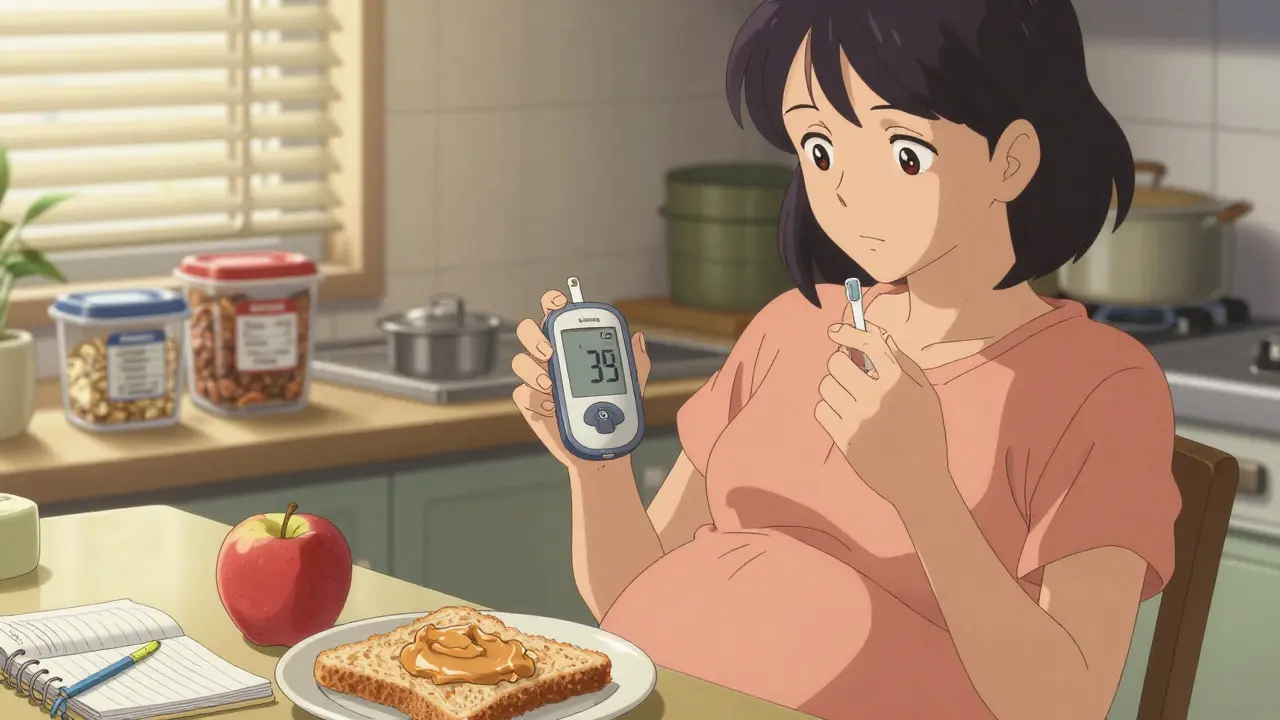
What Is Gestational Diabetes?
Gestational diabetes, or GDM, is high blood sugar that starts during pregnancy in women who didn’t have diabetes before. It happens when hormones from the placenta block insulin from working properly. Your body needs up to three times more insulin during pregnancy, and if your pancreas can’t keep up, glucose builds up in your blood. This usually shows up between weeks 24 and 28, which is why most pregnant women get screened then.
It’s not your fault. You didn’t eat too much sugar or fail at dieting. It’s a normal physiological change that affects 2 to 10% of pregnancies in the U.S. each year. The good news? With the right tools, you can keep your blood sugar in range and have a healthy pregnancy.
Why Managing Blood Sugar Matters
Uncontrolled gestational diabetes doesn’t just affect you-it affects your baby. High blood sugar crosses the placenta, telling your baby’s pancreas to make extra insulin. That insulin acts like a growth hormone, which can lead to a large baby (over 8 pounds 13 ounces). This increases the risk of shoulder dystocia during delivery, C-sections, and birth injuries.
Your baby is also at higher risk for low blood sugar right after birth, breathing problems, and jaundice. Long-term, children born to mothers with unmanaged GDM are more likely to develop obesity and Type 2 diabetes later in life.
For you, the risks include preeclampsia, a serious condition involving high blood pressure, and a 50% chance of developing Type 2 diabetes within 10 years after giving birth. But here’s the key point: if you keep your blood sugar within target ranges, your pregnancy outcomes are nearly the same as women without GDM.
What Are the Blood Sugar Targets?
There’s no guesswork here. The American Diabetes Association sets clear goals for pregnant women with gestational diabetes:
- Fasting and before meals: under 95 mg/dL
- One hour after eating: under 140 mg/dL
- Two hours after eating: under 120 mg/dL
These numbers aren’t arbitrary. They’re based on decades of research showing that staying below these levels reduces the risk of complications. Some doctors use continuous glucose monitors (CGMs), which give you real-time data. Studies show CGMs cut the risk of having a very large baby by nearly 40% and lower the chance of your baby needing NICU care by over half.
If you’re using a fingerstick meter, check your blood sugar at least four times a day-fasting and one hour after each meal. Writing down what you ate along with your numbers helps spot patterns. For example, if your post-lunch readings are always high, your lunch might have too many carbs.
Diet: The First Line of Defense
Most women-70% to 85%-can control their blood sugar with diet and movement alone. No medication needed.
Carbohydrates are the main driver of blood sugar spikes, so you need to manage them smartly. Aim for 35-40% of your daily calories from carbs, spread evenly across three meals and two to three snacks. That’s about 45 grams of carbs per meal and 15-30 grams per snack.
Here’s what that looks like in real food:
- One slice of whole grain bread = 15g carbs
- 1/2 cup cooked oatmeal = 15g carbs
- 1 small apple = 15g carbs
- 1 cup cooked brown rice = 45g carbs
Don’t eat carbs alone. Pair them with protein or fat to slow digestion. For example, eat an apple with a tablespoon of peanut butter instead of just the apple. That simple swap can reduce your blood sugar spike by up to 30%.
There’s also a proven eating order that works: protein first, then vegetables, then carbs. A UCSF Health survey found that 74% of women who followed this pattern saw their post-meal glucose drop by 25-40 mg/dL. It’s not magic-it’s physics. Protein and fiber slow how fast sugar enters your bloodstream.
Avoid fruit juice, sugary cereals, white bread, and sweets. They spike your blood sugar fast and leave you hungry again soon after.

Exercise: Move to Lower Sugar
Physical activity makes your cells more sensitive to insulin. That means your body uses glucose more efficiently-even without extra insulin.
The recommendation? At least 30 minutes of moderate exercise five days a week. Brisk walking is the most popular and easiest option. Swimming and prenatal yoga also work well.
The best time to move? Right after meals. A study showed that a 15-30 minute walk after eating can lower your post-meal blood sugar by 20-30 mg/dL. That’s like getting a free, natural dose of insulin.
Many women on Reddit and in support groups swear by morning walks. One woman shared that her fasting numbers dropped 15-25 mg/dL just by walking before breakfast. You don’t need to run a marathon. Just get moving.
When You Need Medication
Even with perfect diet and exercise, about 15-30% of women still need medication. That’s not failure-it’s biology. Your body just needs a little extra help.
Insulin is the gold standard. It doesn’t cross the placenta, so it’s safe for your baby. You’ll likely start with one injection a day, often at bedtime if your fasting sugars are high. Many women are scared of needles, but insulin pens are small, quiet, and nearly painless. Most get used to them within a few days.
Metformin is sometimes used off-label, especially in women who refuse insulin. But research is mixed. One major study found that 30% of women on metformin still needed insulin later, compared to 15% on insulin alone. It’s not the first choice, but it’s an option if insulin isn’t feasible.
Your doctor will monitor your levels closely and adjust your treatment. The goal isn’t to avoid medication-it’s to keep you and your baby safe.
What to Do After the Baby Is Born
Most women’s blood sugar returns to normal after delivery. But that doesn’t mean the risk is gone.
You’ll need a glucose test 6 to 12 weeks after giving birth. This is usually a 75-gram oral glucose tolerance test. If your fasting level is above 126 mg/dL or your two-hour level is above 200 mg/dL, you have Type 2 diabetes. If it’s between those numbers, you have prediabetes.
Even if your test is normal, your risk stays high. Half of women with GDM develop Type 2 diabetes within 10 years. The best way to prevent it? Lose 5-7% of your body weight and keep moving. The TODAY2 study showed this cuts your risk by 58% over 15 years.
Get screened every one to two years. And if you plan to get pregnant again, talk to your doctor before conceiving. GDM is more likely to come back-and sooner.

Real-Life Tips That Work
Here’s what women with GDM actually do to stay on track:
- Use MyFitnessPal or a similar app to track carbs. One study found 63% of women who tracked their intake hit their targets more consistently.
- Keep a snack box ready: hard-boiled eggs, cheese sticks, nuts, or Greek yogurt. No last-minute sugar crashes.
- Set phone reminders to check your blood sugar. Missing checks is the #1 reason for poor control.
- Ask for a certified diabetes educator (CDCES). They teach you how to count carbs, read your numbers, and adjust your meals. Most insurance covers this.
- Don’t isolate yourself. Join a support group-online or in person. Women who felt supported were 85% more satisfied with their care.
The biggest mistake? Waiting until after 28 weeks to get tested. If you’re overweight, over 35, or have a family history of diabetes, ask for screening earlier. Early diagnosis means early control-and better outcomes.
What Not to Do
Don’t cut carbs completely. Your baby needs glucose for brain development. Aiming for zero carbs can cause ketosis, which is dangerous in pregnancy.
Don’t ignore fasting highs. If your morning numbers are always above 95 mg/dL, you might need a bedtime snack with protein and a little carb-like 6 crackers and 1 oz of cheese. This stabilizes overnight glucose.
Don’t rely on conflicting advice. Some OBs give different diet tips than endocrinologists. Stick with one expert-preferably a CDCES-and ask them to coordinate with your provider.
You’ve Got This
Gestational diabetes feels overwhelming at first. The tests, the monitoring, the food changes-it’s a lot. But millions of women have walked this path and had healthy babies. You’re not alone. The tools are simple, the goals are clear, and the support is out there. Focus on progress, not perfection. One meal, one walk, one blood sugar check at a time. You’re not just managing diabetes-you’re giving your baby the best start possible.
12 Comments
Sue Stone January 22 2026
Just wanted to say-this post saved my sanity. I was freaking out at 26 weeks, thought I was failing at everything, but now I feel like I can actually do this. Thank you.
dana torgersen January 22 2026
Okay, so… I’ve been doing the protein-first thing? And it’s wild-like, my post-lunch crash? Gone. Like, poof. I swear, it’s not magic, it’s just… physics? And also, I accidentally ate a whole bag of gummy bears yesterday and my glucose spiked to 190? And I cried. And then I ate an egg and some almonds and felt better. So… yeah. It’s a journey.
Andrew Smirnykh January 24 2026
I appreciate how this breaks down the science without shaming. Many sources treat GDM like a personal failure. This doesn’t. That matters more than you’d think.
Stacy Thomes January 24 2026
Y’ALL. I started walking after dinner. JUST 15 MINUTES. And my numbers dropped like I’d turned off a faucet. I did it yesterday. I did it today. I’m gonna do it tomorrow. I’m not just managing diabetes-I’m becoming a warrior. A glucose warrior. And I’m proud.
Anna Pryde-Smith January 25 2026
Why is everyone acting like this is some new discovery? My OB told me this exact stuff in 2018. And now you’re all acting like you just found the holy grail? I’m tired of this performative wellness culture. It’s not revolutionary-it’s basic medicine.
Dawson Taylor January 26 2026
Insulin does not cross the placenta. Metformin may. This is not a trivial distinction. The physiological implications are significant.
Sallie Jane Barnes January 26 2026
Just got my CDCES referral approved. Took three calls and a letter from my midwife. Worth it. She taught me how to read my meter like a book. And I’m not ashamed to say I cried when I saw my first stable reading. This is hard. But it’s doable.
charley lopez January 28 2026
The 75g OGTT at 6–12 weeks postpartum remains the gold standard for diagnostic confirmation. Fasting thresholds of ≥126 mg/dL and 2-hour values ≥200 mg/dL are consistent with ADA 2023 guidelines. Prediabetes is defined by 140–199 mg/dL at 2 hours. Longitudinal cohort data indicate a 58% reduction in T2DM incidence with 5–7% weight loss and ≥150 min/week of moderate activity.
Kerry Evans January 28 2026
Why are people still eating brown rice? It’s basically sugar with a side of fiber. If you’re diabetic, you shouldn’t be eating any grain that isn’t sprouted and fermented. And why are you not on a keto diet? It’s the only way to truly control insulin. You’re all just delaying the inevitable.
Susannah Green January 29 2026
My glucose monitor beeps at 2 a.m. now. I’ve got my snack box next to the bed: 6 crackers + 1 oz cheddar. It’s weird, but it works. I used to think I was being dramatic about morning highs-turns out, I wasn’t. My doctor was like, ‘Yeah, that’s a thing.’ And now I’m a believer. Also-don’t skip the postpartum test. Seriously. Do it.
Kerry Moore January 29 2026
I appreciate the nuance in addressing both insulin and metformin. The data on metformin’s efficacy in pregnancy remains inconclusive, particularly regarding long-term neonatal outcomes. A 2022 meta-analysis in *Diabetes Care* suggests increased risk of preterm birth compared to insulin monotherapy. Clinical decisions should be individualized.
Oladeji Omobolaji January 29 2026
Back home in Nigeria, no one talks about this. My cousin had GDM and no one told her anything. She had a 10-pound baby and nearly died. I’m sharing this with my whole family. Thank you.