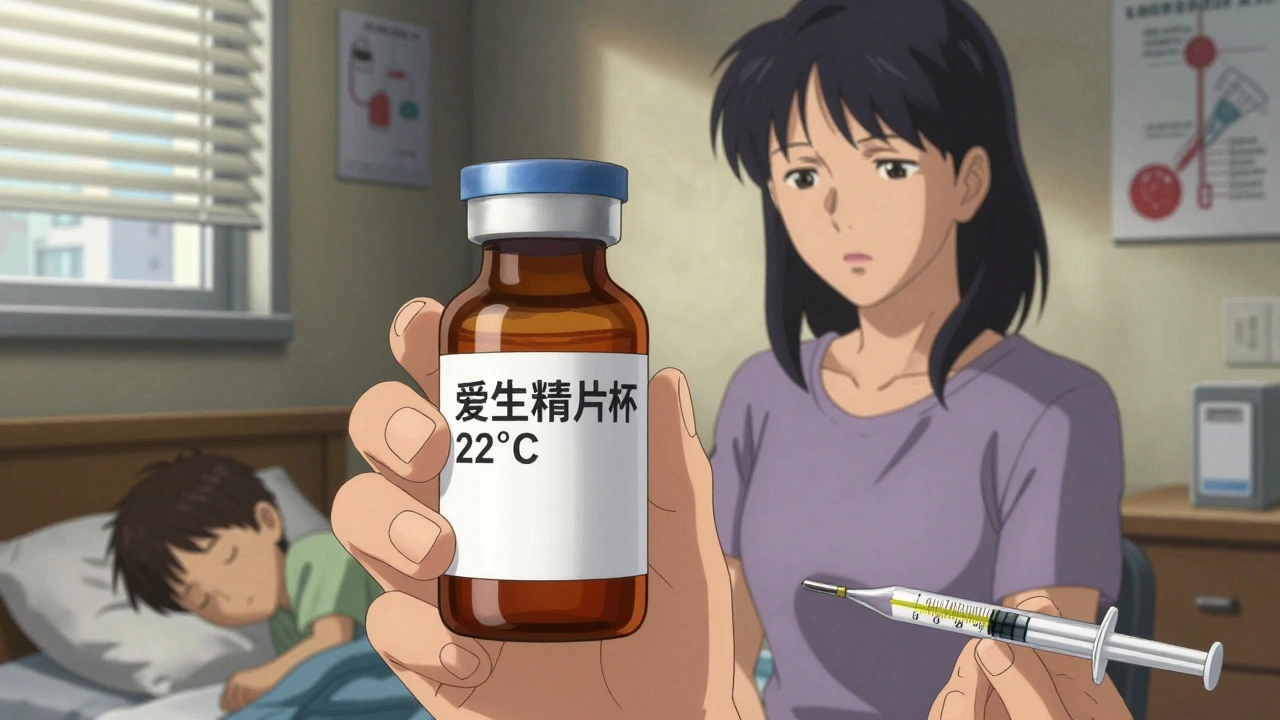
When your child gets an antibiotic suspension from the pharmacy, it’s not just about giving the right dose-it’s about keeping it effective. Many parents assume all liquid antibiotics need to go in the fridge. That’s not true. Some will actually break down if chilled. Others lose potency fast if left on the counter. Get it wrong, and the infection might not clear. Worse, your child could end up needing another round of antibiotics-or worse, develop resistance.
Not All Liquid Antibiotics Need the Fridge
Here’s the big myth: refrigeration makes all liquid antibiotics last longer. It doesn’t. Some, like amoxicillin, are fine at room temperature. Others, like certain penicillin-based suspensions, absolutely need to be kept cold. The difference isn’t just about convenience-it’s about chemistry.
According to the Cleveland Clinic, amoxicillin suspension can be stored at room temperature (between 20°C and 25°C or 68°F and 77°F) without losing strength. Refrigeration is optional. If you do refrigerate it, that’s fine. But don’t assume it’s required. On the other hand, amoxicillin-clavulanate (Augmentin) is more sensitive. While some sources say it’s okay at room temperature for up to 5 days, others recommend refrigeration and discarding after 10 days. Why the confusion? Because the two parts of this combination drug degrade at different rates. The amoxicillin holds up better than the clavulanate. So even if the liquid still looks fine, the clavulanate may have weakened, making the whole dose less effective.
Walgreens pharmacists warn that refrigerating certain antibiotics can actually harm them. Some formulations contain ingredients that crystallize or separate when chilled. Once that happens, shaking won’t fix it. The medication might still be safe to swallow-but it won’t work as intended. That’s why the label is your best friend. Always check the instructions printed on the bottle or the paper insert. If it says "store in the refrigerator," do it. If it says "store at room temperature," leave it out.
How Long Do Reconstituted Antibiotics Last?
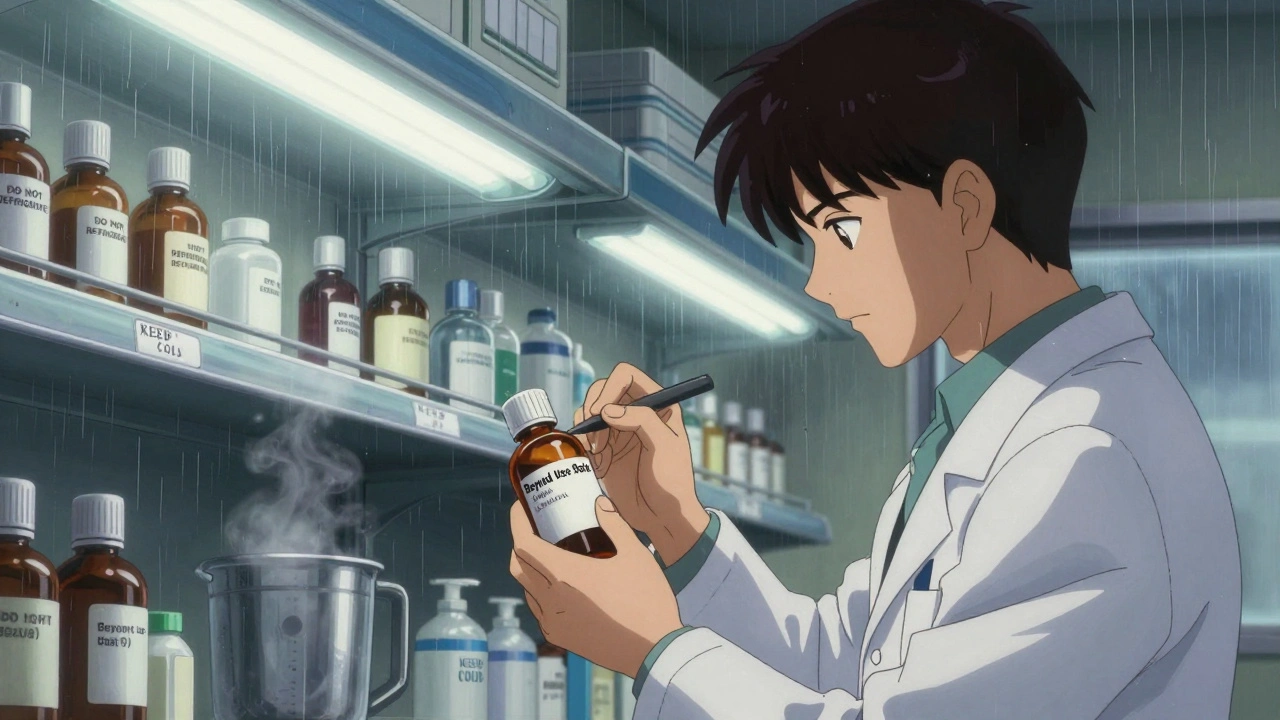
Once you mix the powder with water, the clock starts ticking. Commercially prepared suspensions come with a "beyond use date"-not an expiration date. That’s because stability changes after reconstitution. The FDA requires manufacturers to test these products under real-world conditions to set this date, but it varies wildly.
For amoxicillin suspension, the Cleveland Clinic says you can keep it for up to 14 days, whether refrigerated or not. That’s longer than most people expect. But for amoxicillin-clavulanate, the window shrinks. A 2013 study in JAPSONLINE found it stayed stable for only five days at room temperature (27-29°C). Other sources say 10 days if refrigerated. There’s no universal rule. That’s why your pharmacist should tell you exactly how long to keep it-and they usually write it right on the label.
Don’t guess. If you’re unsure, throw it out. Using an old or degraded antibiotic doesn’t just mean a wasted dose. It means your child’s body is being exposed to sub-therapeutic levels of the drug. That’s how antibiotic resistance starts. Bacteria don’t die-they adapt. And once they do, the next infection becomes harder to treat.
Temperature Isn’t the Only Factor
Heat and cold aren’t the only enemies. Light, moisture, and time all play a role. The FDA says drug stability is tested under specific humidity and light conditions. That’s why you should never store antibiotics on the windowsill, in the bathroom cabinet, or inside a hot car.
One study found that improper storage-like leaving suspensions on open shelves in homes without air conditioning-accelerated degradation. That’s especially true in places with unreliable power or high humidity. Even in New Zealand, where summers can get warm, leaving a bottle in a sunlit kitchen can reduce potency.
Freezing is a no-go. Don’t put antibiotics in the freezer. Like insulin, many are made of proteins or complex molecules that break down when frozen. You might think cold equals safe, but freezing can cause irreversible damage. If you’re traveling and worried about heat, use a cool pack or insulated bag. But don’t let the bottle touch ice directly. Condensation can get inside the cap and ruin the suspension.
How to Measure Doses Accurately
Storing the medicine right is half the battle. Giving the right dose is the other half. Household spoons? Don’t use them. A teaspoon from your kitchen can vary by 20-30% in volume. That’s not a small error-it’s dangerous.
Always use the oral syringe, dropper, or measuring spoon that came with the bottle. If it’s missing, ask the pharmacy for a new one. They’ll give it to you free. Some pharmacies even offer digital dosing apps that remind you when to give the next dose and track how much is left.
Shake the bottle well before each use. Suspensions settle. The antibiotic powder sinks to the bottom. If you don’t shake it, your child might get too little in one dose and too much in the next. That’s why the label says "shake well before each use." It’s not a suggestion-it’s a requirement for effectiveness.
What Happens If You Use an Old or Improperly Stored Antibiotic?
Let’s be clear: you won’t necessarily get sick from taking an old antibiotic. But the infection might not go away.
Baystate Health reports that improperly stored antibiotics fail to clear infections in about 30% of cases where storage was incorrect. That means your child might still have a fever, cough, or ear pain after finishing the bottle. Parents often think, "The medicine didn’t work," when the real problem is the medicine degraded before it was even taken.
Worse, incomplete treatment encourages resistant bacteria. If the dose is too weak, the strongest bugs survive. They multiply. Next time, you’ll need a stronger antibiotic-or one with more side effects. That’s not just a personal risk. It’s a public health issue.
The FDA says expiration dates only apply if the drug was stored properly. If you kept it in a hot car for a week, the expiration date means nothing. The drug might be useless long before that date.
What to Do With Leftover Antibiotics
Never flush them down the toilet or toss them in the trash. Even expired or unused antibiotics can pollute water supplies or end up in the hands of kids or pets.
Most pharmacies in New Zealand and the U.S. offer take-back programs. Bring your leftover suspension to the pharmacy where you got it. They’ll dispose of it safely. If that’s not an option, mix the liquid with an unpalatable substance-like coffee grounds or cat litter-pour it into a sealed container, and throw it in the trash. Remove the label first to protect privacy.
And don’t save it for next time. Antibiotics are not like painkillers. You can’t use them for a different infection. What worked for an ear infection won’t help with strep throat. Each prescription is tailored to a specific bug. Using the wrong one is risky.
Key Takeaways: Quick Storage Rules
- Check the label first-don’t assume refrigeration is needed.
- Amoxicillin can go at room temperature (20-25°C) for up to 14 days.
- Amoxicillin-clavulanate should be refrigerated and used within 10 days (or 5 days if left out).
- Never freeze or expose to direct sunlight.
- Always shake before each dose.
- Use the measuring tool provided-not a kitchen spoon.
- When in doubt, throw it out.
- Return unused medicine to the pharmacy for safe disposal.
When to Call Your Pharmacist or Doctor
Call if:
- The liquid looks cloudy, discolored, or has particles you can’t shake out.
- You’re unsure whether to refrigerate or not.
- Your child’s symptoms haven’t improved after 48 hours.
- You missed a dose and aren’t sure whether to skip or double up.
Pharmacists are trained to answer these questions. Don’t hesitate to ask. It’s part of their job.
Can I store liquid antibiotics in the fridge even if the label doesn’t say to?
Sometimes yes, sometimes no. Refrigerating antibiotics that don’t require it can cause them to degrade faster or separate. Always follow the label. If it doesn’t mention refrigeration, store it at room temperature. If you’re unsure, ask your pharmacist.
How do I know if my antibiotic suspension has gone bad?
Look for changes in color, texture, or smell. If it’s clumpy, unusually thick, smells sour, or has visible particles that won’t dissolve after shaking, throw it out. Even if it looks fine past the beyond-use date, don’t risk it.
Why do some antibiotics last longer than others?
It depends on the chemical structure. Some antibiotics, like amoxicillin, are more stable in water. Others, like clavulanate, break down quickly. Manufacturers design each suspension differently, and stability testing determines how long each one lasts. That’s why there’s no one-size-fits-all rule.
Can I mix leftover antibiotic with food to make it easier for my child to take?
Yes, if the label allows it. Many antibiotics can be mixed with applesauce, yogurt, or juice to improve taste. But don’t mix it in advance. Add it to food right before giving the dose. Also, avoid acidic drinks like orange juice with some antibiotics-they can interfere with absorption. Always check with your pharmacist first.
What if I accidentally left my child’s antibiotic in the car overnight?
If it got too hot (above 30°C) or froze, throw it away. Even if it looks normal, the active ingredients may have degraded. Don’t risk using it. Call your pharmacy-they can often provide a replacement, especially if it’s a child’s prescription.
13 Comments
Justin Hampton December 2 2025
I've been storing all my kid's antibiotics in the fridge for years. You're telling me I've been wasting money and time? That's ridiculous. I'll believe it when I see the FDA study that says room temp is better. Until then, I'm keeping it cold.
Pooja Surnar December 2 2025
u r sooo wrong!! amoxil always goes in fridge!! my cousin's kid got sepsis bcs mom left it on counter!! u r a danger to society!!
Sandridge Nelia December 3 2025
This is so helpful!! 🙌 I always assumed fridge = better, but now I'm checking labels. Also, the part about not using kitchen spoons? YES. I just got a new syringe from the pharmacy today. So glad I didn't wing it. Thank you for the clear breakdown!
Mark Gallagher December 4 2025
The fact that people still don't know this is why America's healthcare system is failing. You don't get to guess with antibiotics. This isn't cooking. It's science. If you can't follow a label, you shouldn't be parenting. The FDA has standards for a reason. Stop being lazy.
Wendy Chiridza December 4 2025
I used to think refrigeration was mandatory until my pharmacist corrected me last year. Now I always read the insert. Shaking before each dose is non-negotiable. My daughter had an ear infection last month and we followed every step. No recurrence. Just simple stuff done right
Pamela Mae Ibabao December 4 2025
Let me break this down for you like you're five. Refrigerating some antibiotics = bad. Not shaking = bad. Using a spoon = worse. Leaving it in the car = criminal negligence. The fact that this even needs explaining is terrifying. We're failing our kids with ignorance.
Gerald Nauschnegg December 5 2025
I just got back from the pharmacy and asked them about this. They said amoxicillin is fine at room temp for 14 days but Augmentin? Refrigerate it or it's garbage. Also, they gave me a free syringe and told me to never freeze it. So I'm just gonna say this - pharmacists are the real MVPs. They know way more than Google.
Katey Korzenietz December 6 2025
I read this and immediately checked my fridge. Turns out I've been storing amoxicillin wrong for 3 years. I'm mortified. I'm throwing it out. And yes I did use a spoon. I'm so sorry my daughter.
Chris Jahmil Ignacio December 6 2025
This is all part of the pharmaceutical-industrial complex. They make these drugs unstable on purpose so you have to buy more. The FDA doesn't care. They're paid off. Refrigeration? That's a myth created by Big Pharma to sell more bottles. Why would they want you to use one bottle for 14 days? No profit in that. Wake up. The truth is hidden behind labels and 'stability studies'.
Paul Corcoran December 8 2025
I'm so glad someone wrote this. I've been a nurse for 12 years and I see parents stress over this every week. You're not alone. If you're unsure, call your pharmacy. They don't mind. Seriously. They'd rather you call than risk your kid's health. And if you're tired of reading labels? Just take a photo and send it to your pharmacist. They'll reply in 10 minutes. You're doing better than you think.
Stacy Natanielle December 10 2025
I appreciate the technical accuracy of this post. However, I must emphasize the importance of adherence to manufacturer-specific stability data, which may vary by formulation, excipient composition, and regional regulatory interpretations. 📊✨ Additionally, environmental variables such as relative humidity and photodegradation kinetics are often underappreciated in home storage scenarios. Please consult the product monograph for definitive guidance. 🌡️🧪
kelly mckeown December 10 2025
i just realized i left my son's antibiotic in the bathroom for a week... it was humid and hot. i feel awful. i threw it out and called the pharmacy. they gave me a new one for free. thank you for this. i didn't know any of this. i'm trying to be better.
Tom Costello December 12 2025
This is the kind of post that reminds me why I love this community. No drama. Just facts. And a little bit of compassion. I'm from the Philippines and we don't always have AC or reliable fridges. This info? Lifesaver. Thanks for writing it clearly.