
If you have Meniere’s disease, you know how sudden vertigo attacks can turn your world upside down. One moment you’re fine, the next you’re gripping the kitchen counter, nauseous, ears ringing, and feeling like your head is stuffed with cotton. Hearing comes and goes. Tinnitus screams in your ear. And no matter how much rest you get, it doesn’t stop. The good news? What you eat and drink can make a real difference - not just ease symptoms, but reduce how often they hit.
Why Salt Is the Main Culprit
Meniere’s isn’t caused by an infection or a tumor. It’s about fluid pressure in your inner ear. That fluid - called endolymph - builds up when your body holds onto too much water. And salt is the biggest reason why that happens. Every gram of sodium you eat pulls water into your bloodstream, and eventually, into your inner ear. When that fluid can’t drain properly, pressure builds. That’s what triggers vertigo, muffled hearing, and the roaring in your ears.Doctors have known this since the 1920s. But now, modern research confirms it. A 2024 study in Acta Otolaryngologica followed 50 people with moderate to severe Meniere’s. Those who cut sodium to 1,500 mg per day and drank 35 ml of water per kilogram of body weight saw their vertigo attacks drop by nearly half. Their hearing improved by an average of 12.3 decibels. Tinnitus got quieter. The dizziness scores fell by more than 50%. This wasn’t a guess. It was a controlled trial - the strongest kind of evidence we have.
How Much Sodium Is Too Much?
You don’t need to go salt-free. But you do need to cut way back. Most people in the U.S. eat over 3,400 mg of sodium a day. That’s more than double what Meniere’s patients should have.The sweet spot? Between 1,500 and 2,000 mg per day. That’s about three-quarters of a teaspoon of table salt. The American Heart Association says that’s the ideal limit for most adults - and it’s exactly what otolaryngologists recommend for Meniere’s. The NIH suggests staying under 2,000 mg. Some experts, like Dr. Richard Miyashita in Tokyo, say even 3,000 mg is too high for people with frequent attacks. But if you’re just starting out, aim for 2,000 mg. Once you get used to it, drop to 1,500.
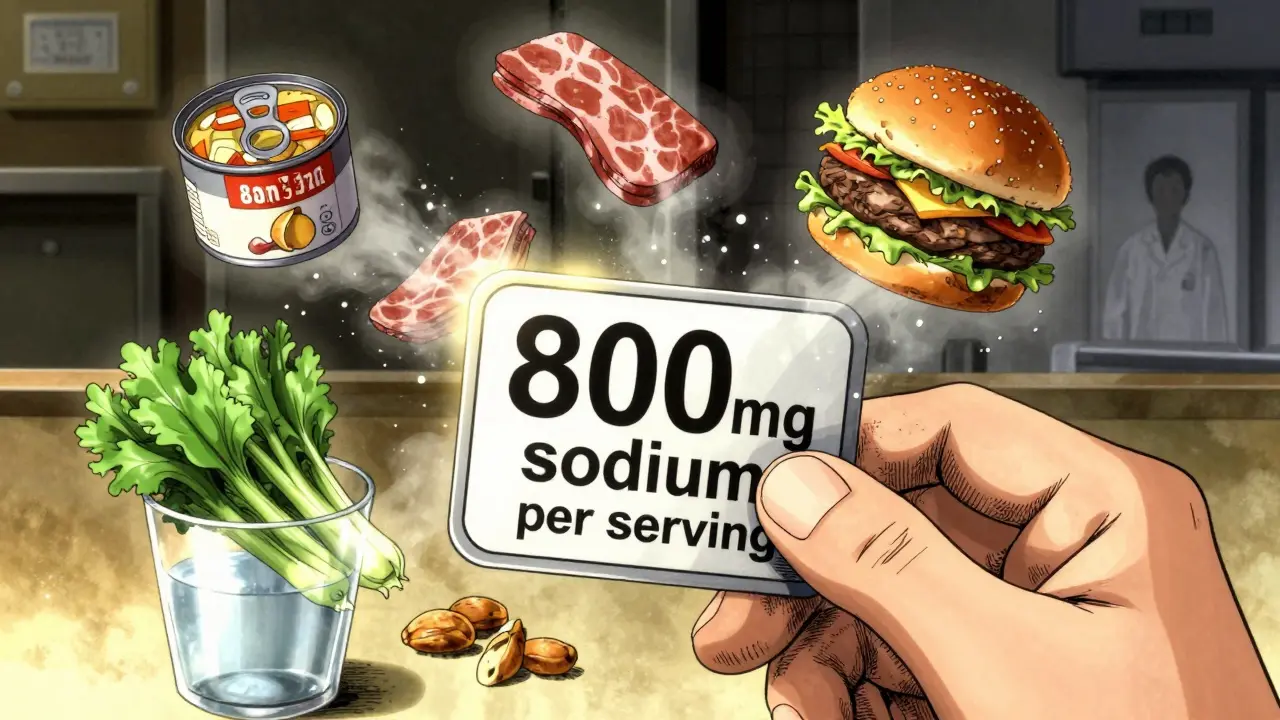
Here’s the catch: 77% of the sodium you eat doesn’t come from your salt shaker. It’s in bread, soup, canned veggies, deli meats, sauces, and restaurant meals. A single slice of store-bought bread can have 230 mg. A cup of canned chicken noodle soup? Over 800 mg. A fast food burger? Often more than 1,000 mg. That’s your entire daily limit gone before lunch.
What to Eat - and What to Avoid
Start by cleaning out your pantry. Here’s what to ditch:- Processed meats: bacon, ham, salami, hot dogs
- Canned soups and vegetables (unless labeled “no salt added”)
- Soy sauce, Worcestershire sauce, ketchup, mustard, relish
- Pre-packaged meals: frozen pizzas, pasta dishes, instant rice
- Snacks: chips, pretzels, crackers, salted nuts
- Fast food and restaurant meals - especially anything with “seasoned” or “crispy” on the menu
What should you eat instead?
- Fresh fruits and vegetables - they’re naturally low in sodium
- Unsalted nuts and seeds
- Plain rice, quinoa, oats
- Fresh or frozen chicken, fish, turkey (no brining or marinades)
- Low-sodium beans (rinse canned ones well)
- Herbs and spices: garlic, rosemary, cumin, paprika, lemon juice
Read labels. Look for “no salt added” or “low sodium” - but check the actual mg per serving. A product labeled “low sodium” can still have 140 mg per serving. That’s okay if you’re eating one serving. But if you eat two, you’ve used up 280 mg. And you’re not even halfway through the day.
Fluid Balance: Drink More Water, Not Less
You might think, “If salt makes me retain water, maybe I should drink less.” But that’s the wrong move. Dehydration makes your body hold onto even more fluid - including in your inner ear.The 2024 study didn’t just cut sodium. It also told people to drink 35 ml of water per kilogram of body weight every day. That’s about 2.5 liters for a 70 kg (154 lb) person. Not a gallon. Not excessive. Just enough to keep your body from panicking and hoarding fluid.
Spread your water intake out. Don’t chug it all at once. Sip through the day. Avoid alcohol and caffeine. Both act as diuretics, but they also tighten blood vessels in the inner ear, making symptoms worse. One cup of coffee or glass of wine might not seem like much - but for someone with Meniere’s, it can trigger an attack hours later.
Why Diet Beats Pills
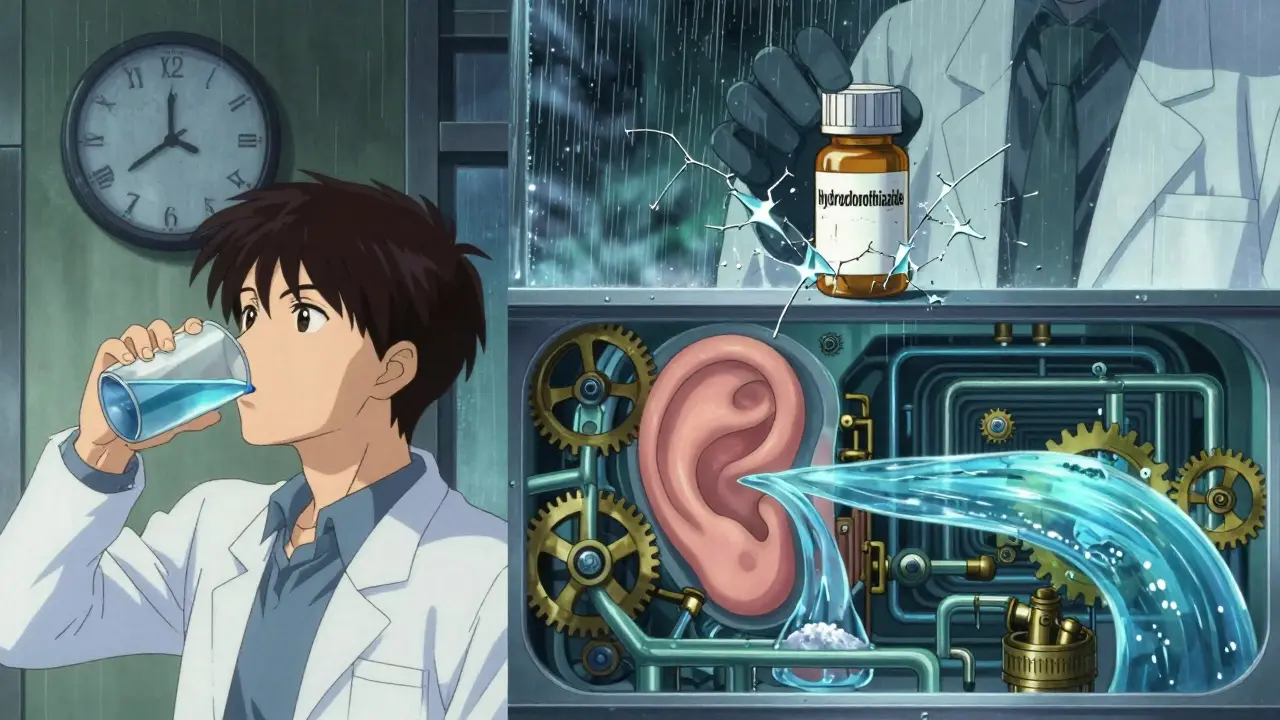
Many doctors prescribe diuretics like hydrochlorothiazide. They help flush out fluid. But they come with side effects: dizziness, low potassium, muscle cramps, even kidney stones. And they don’t fix the root problem - your body’s salt overload.Dietary changes? No side effects. No prescriptions. No pharmacy trips. Just you, your kitchen, and your body learning to balance itself again. A 2018 study found that 68% of people who stuck to a low-sodium diet saw major symptom improvement. That’s better than most drugs.
And it’s cheaper. A month’s supply of hydrochlorothiazide costs $10-$20. But a month of fresh produce, lean meats, and whole grains? Maybe $50-$70. And you’re not just treating Meniere’s - you’re lowering your risk of high blood pressure, heart disease, and stroke.
Real-Life Challenges - And How to Beat Them
This isn’t easy. Social events become minefields. Family dinners turn into stress tests. You’re the person who says “no thanks” to the appetizer platter. You ask for “no salt” at restaurants - and sometimes get a look like you’re crazy.Here’s how to make it stick:
- Plan meals ahead. Cook in batches on weekends. Freeze portions so you’re never stuck with takeout.
- Keep low-sodium snacks on hand: unsalted popcorn, apple slices with almond butter, hard-boiled eggs.
- Use salt-free spice blends. Brands like Mrs. Dash or homemade mixes (garlic powder, onion powder, black pepper, paprika) work great.
- When dining out, ask for dishes to be prepared without salt or sauce. Most restaurants will accommodate you.
- Track your sodium for a week with a free app like MyFitnessPal. You’ll be shocked at how fast it adds up.
And be patient. It takes 4-8 weeks for your taste buds to adjust. At first, food will taste bland. But after a month, you’ll start noticing flavors you never noticed before - the sweetness of tomatoes, the earthiness of mushrooms, the brightness of lemon.
What If It Doesn’t Work?
Not everyone responds. Some people stick to the diet for months and still have attacks. That doesn’t mean it’s useless. It just means you need to combine it with other strategies.Doctors often layer treatments: diet first, then vestibular rehab exercises, then medications, then injections. Intratympanic steroid injections (injections into the ear) help 60-75% of people who don’t respond to diet alone. Gentamicin injections are more aggressive - they can stop vertigo in 80-90% of cases, but they carry a risk of hearing loss.
Right now, the NIH is running a major trial called the Meniere’s Dietary Intervention Trial (NCT04567891). It’s comparing 1,500 mg vs. 2,300 mg sodium limits over 12 months. Results are due in late 2025. That might finally give us clearer answers.
But here’s the bottom line: even if the science isn’t perfect, the risks of a low-sodium diet are near zero. The potential rewards? Fewer vertigo attacks, better hearing, less ringing, more control over your life.
Start Today - One Meal at a Time
You don’t need to overhaul your whole life tomorrow. Start with one change: swap your morning toast with butter and jam for oatmeal made with water and cinnamon. Skip the soy sauce on your stir-fry. Use lemon and herbs instead. Choose fresh chicken over deli meat. Drink a glass of water before breakfast.Meniere’s doesn’t have a cure. But for many people, the diet is the closest thing to one. It’s not magic. It’s science. And it’s within your reach.
11 Comments
Angela Stanton January 8 2026
Okay but let’s be real - 1,500mg sodium is a myth unless you’re living in a lab. I tracked my intake for 3 days using MyFitnessPal and accidentally hit 2,100mg just from one ‘low-sodium’ frozen curry and a ‘healthy’ granola bar. 🤯 The labels are lies. Also, why is everyone acting like this is new? My grandma in ’98 was telling me to skip the soy sauce before TikTok even existed. 🍜
Johanna Baxter January 8 2026
I tried this diet for 2 weeks and ended up crying in the grocery store because my favorite chips didn’t have ‘no salt added’ and I felt like my whole identity was being erased. My mom said I was being dramatic. I told her if she had Meniere’s she’d understand. She didn’t. So I ate a whole bag of salted almonds. And I don’t regret it. 🥲
Heather Wilson January 9 2026
While the 2024 Acta Otolaryngologica study is methodologically sound, it suffers from selection bias - participants were recruited from tertiary care centers, inherently skewing toward more severe cases. Additionally, the 35 mL/kg water intake protocol assumes normal renal function, which is rarely accounted for in these cohorts. Without controlling for comorbid hypertension or renal biomarkers, the causal inference remains tenuous. This is not evidence; it’s correlation dressed as protocol.
Micheal Murdoch January 9 2026
What I love about this post isn’t just the science - it’s the humanity behind it. Meniere’s doesn’t just mess with your ears, it messes with your sense of safety in your own body. Cutting sodium isn’t about willpower - it’s about reclaiming control. I’ve seen patients go from bedridden to hiking again just by switching from canned soup to homemade broth. It’s not a cure, but it’s a lifeline. And yeah, food will taste weird at first. But eventually, you start tasting the difference between survival and living.
Chris Kauwe January 10 2026
Western medicine is failing us. This isn’t about sodium - it’s about the globalist food industry poisoning us with processed garbage. China and India have been eating clean for centuries. We’re the ones who turned salt into a weapon. If you’re still buying ‘low-sodium’ packaged food, you’re still playing their game. Go back to the land. Grow your own. Stop trusting corporations. Your inner ear will thank you.
Meghan Hammack January 11 2026
OMG I did this and my vertigo went from 5x a week to once a month!! I started with just swapping my lunch sandwich for a tuna salad with olive oil and lemon. No mayo. No salt. And now I actually like how food tastes?? Like… I can taste the basil now?? I’m crying. This is the best thing I’ve ever done for myself. 🙏💖
RAJAT KD January 12 2026
Scientifically accurate. Sodium restriction works. But water intake must be consistent. Dehydration triggers endolymphatic hydrops. Drink slowly. Not all at once. Avoid caffeine. No exceptions. Track for 30 days. Results are inevitable.
Matthew Maxwell January 13 2026
It is both irresponsible and misleading to suggest that dietary modification alone constitutes a viable therapeutic strategy for Meniere’s disease. The NIH itself acknowledges that only 60–70% of patients respond to low-sodium protocols. To imply otherwise is to undermine the clinical authority of otolaryngology and mislead vulnerable patients into abandoning evidence-based pharmacotherapy. This post is dangerously oversimplified.
Lindsey Wellmann January 13 2026
I just wanna say… I made my own spice blend 🌿✨ and now I feel like a chef AND a warrior. Also I cried when I realized I hadn’t had an attack in 18 days. I’m not just surviving. I’m thriving. And yes, I did buy a tiny ‘no salt’ flag for my fridge. 🏳️🌈 #MenieresWarrior #TasteTheFreedom
Ian Long January 15 2026
I get why people get defensive about this. I used to think ‘just eat less salt’ was lazy advice too. But then I saw my sister go from needing a wheelchair to walking her dog again - no meds, just food changes. It’s not magic. It’s biology. And yeah, it’s hard. But if we can agree that food is medicine, then why are we still arguing about whether or not to use it?
Pooja Kumari January 16 2026
Look, I’ve had Meniere’s for 12 years. I’ve tried everything. Diuretics made me dizzy all day. Steroid shots gave me cataracts. I tried the diet for 6 months and thought it was a scam - until one day, I woke up and realized I hadn’t felt that pressure in my ear for 72 hours. It didn’t fix everything. But it gave me back the quiet. The silence between the ringing. And that? That’s worth every bland meal. I don’t need a miracle. I just need a little peace. And now, I have it.