
Ever stepped on the scale after weeks of eating better, moving more, and sleeping well-only to see the same number staring back? You feel like you’ve done everything right, but the scale won’t budge. It’s frustrating. And it’s not your fault. The scale doesn’t tell the whole story.
Why the Scale Lies to You
The number on the scale is just one data point. It doesn’t know if you’ve lost fat and gained muscle. It doesn’t know if your blood sugar is steadier, your joints feel lighter, or you’re sleeping through the night without reaching for that third cup of coffee. It doesn’t know if you finally cooked a meal at home instead of ordering takeout-or if you walked up the stairs without getting winded. Daily weight swings of 2 to 5 pounds are normal. They’re caused by water retention, sodium intake, hormonal cycles, bowel movements, or even how much you drank the night before. If you’re basing your self-worth or progress on a number that changes with your last meal, you’re setting yourself up for disappointment. Real health changes don’t always show up on the scale. But they show up everywhere else.What Are Non-Scale Victories?
Non-scale victories (NSVs) are measurable improvements in your health, energy, mood, or daily function that have nothing to do with your weight. They’re the quiet wins-the ones you might not even notice if you’re only watching the scale. These aren’t vague feelings. They’re concrete changes:- Waking up without an alarm because you’re naturally rested
- Not needing your seat belt extender on a flight
- Putting on socks without holding onto the counter
- Going for a walk after dinner instead of collapsing on the couch
- Choosing water over soda without thinking about it
- Being able to cross your legs comfortably while sitting
- Getting through a workday without a sugar crash
- Feeling less bloated after meals
- Having more patience with your kids or partner
The Four Categories of Real Progress
Health professionals now track non-scale victories in four key areas. These aren’t just nice-to-haves-they’re clinical indicators of long-term health.1. Biochemical Improvements
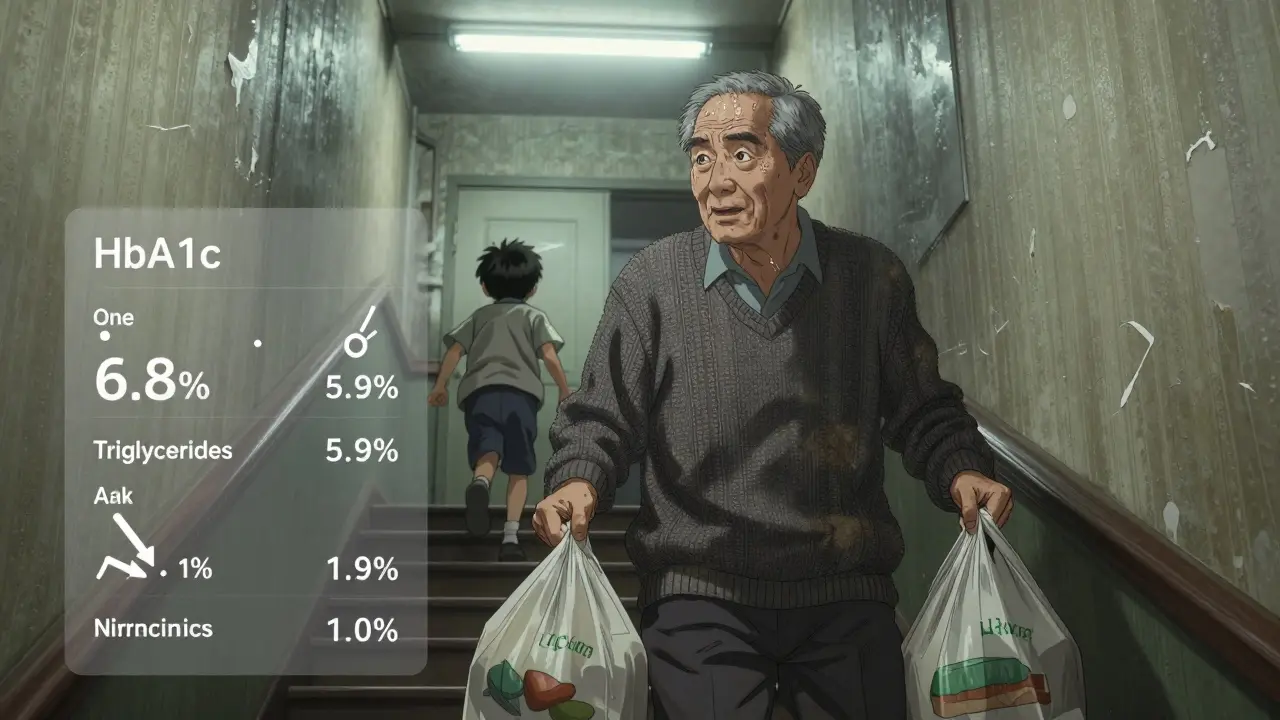
Your body is running lab tests every day, even if you’re not. And these tests don’t lie.- Your HbA1c dropped from 6.8% to 5.9%-meaning your blood sugar is more stable
- Your triglycerides fell by 40%
- Your blood pressure is now normal without medication
- Your liver enzymes returned to normal range
2. Functional Gains
This is about what your body can actually do.- You can carry groceries up two flights of stairs without stopping
- You no longer need help getting out of a low chair
- You’re walking 30 minutes a day, five days a week
- You’ve started swimming, dancing, or gardening-something you haven’t done in years
- Your joint pain has decreased enough to wear shoes without discomfort
3. Behavioral Shifts
Habits are the foundation of lasting change. And habits are easier to track than weight.- You’ve cooked dinner at home four nights this week
- You’ve stopped buying sugary drinks and switched to sparkling water
- You’re reading food labels before buying anything
- You’re eating slowly and stopping when you’re full
- You’ve stopped skipping breakfast because you know it helps your energy
4. Psychosocial Wins
This is where the real transformation happens-in your mind.- You no longer feel guilty after eating a slice of cake
- You’ve stopped checking your reflection in every window
- You’re saying “no” to food pressure from others without feeling bad
- You’ve started journaling your emotions instead of eating them
- You feel more confident in your own skin, even if your size hasn’t changed
How to Track Your Own Non-Scale Victories
You can’t improve what you don’t measure. But you don’t need a fancy app or a journal with 50 columns. Start simple:- Choose one area to focus on this week: energy, sleep, movement, or mood
- Write down one small win each day-even if it’s just “I drank a full glass of water before lunch”
- At the end of the week, read them back. Notice how much you’ve actually done
- Repeat next week with a new focus
- Instead of: “I want to move more” → Try: “I will walk for 20 minutes after dinner, three days this week”
- Instead of: “I want to eat better” → Try: “I will replace one sugary snack with fruit or nuts every day”
- Instead of: “I want to feel less stressed” → Try: “I will take five deep breaths before checking my phone in the morning”
Why This Works Better Than Weight Loss Alone
Studies show that people who focus on non-scale victories are more likely to keep weight off for years. Why? Because they’re not chasing a number-they’re building a life. The National Institutes of Health found that in obesity treatment programs, patients rated non-scale victories as equally important as weight loss itself. That’s not a fluke. It’s science. When you fixate on weight, you’re chasing a single, unstable metric. When you focus on energy, sleep, mood, movement, and habits-you’re building a foundation that lasts. One woman in Christchurch, who had struggled with weight for 20 years, told her dietitian: “I didn’t lose much on the scale. But I haven’t needed my insulin for six months. I’m playing with my grandkids without getting tired. And I finally feel like I’m in control.” That’s not a failure. That’s a win.
What to Do When the Scale Doesn’t Move
If the scale hasn’t budged in weeks, don’t panic. Ask yourself:- Have I slept better?
- Do I have more energy in the afternoon?
- Have I stopped reaching for snacks out of boredom?
- Did I cook a meal from scratch this week?
- Have I been kinder to myself?
Real Talk: What People Actually Celebrate
Here are real non-scale victories from people just like you:- “I wore jeans I haven’t fit into since college-and didn’t need a belt.”
- “I didn’t need my inhaler during my walk last week.”
- “I laughed so hard I cried at a movie. I hadn’t done that in years.”
- “My doctor said my cholesterol is now in the healthy range.”
- “I went to a family gathering and didn’t feel ashamed of what I ate.”
- “I woke up before my alarm. I didn’t even know I could do that.”
- “I said no to a second helping-and didn’t feel deprived.”
Final Thought: Progress Isn’t Linear. Neither Is Health.
You don’t need to lose 50 pounds to be healthy. You don’t need to run a marathon to be strong. You don’t need to be thin to be thriving. Health isn’t a destination on a scale. It’s the way you wake up. The way you move. The way you eat. The way you feel about yourself. Celebrate the wins that matter. The ones that last. The ones that make you feel alive. Your body isn’t broken. It’s adapting. And it’s doing better than you think.Can I still use the scale if I focus on non-scale victories?
Yes, but don’t let it dictate your mood or self-worth. Use it as one of many tools-not the main one. Weigh yourself no more than once a week, at the same time of day, and only after using the bathroom. Focus more on trends over months than daily numbers. Your non-scale victories are the real indicators of progress.
What if I don’t see any non-scale victories after a few weeks?
It’s common to miss small changes at first. Try keeping a daily journal for two weeks. Write down one thing you did for your health each day-even if it’s small. After a week, look back. You might be surprised. Sometimes progress is quiet. It doesn’t always shout. Look for shifts in energy, sleep, digestion, or mood. These are often the first signs of change.
Do non-scale victories work for people with diabetes or high blood pressure?
Absolutely. In fact, they’re even more important. For people with diabetes, stable blood sugar and lower HbA1c are far more meaningful than weight loss. For high blood pressure, reduced medication needs and better sleep are direct signs of improvement. These are clinical markers that predict long-term health-and they often improve before weight does.
How do I stop comparing myself to others who are losing weight faster?
Your journey is yours alone. Someone else’s scale doesn’t reflect your health. Someone else’s meal plan might not suit your body. Someone else’s story doesn’t define your progress. Focus on your own non-scale victories. Write them down. Celebrate them. When you start measuring your success by how you feel, not how you look, comparison loses its power.
Can non-scale victories help me stay motivated long-term?
Yes-because they’re tied to real life, not a number. When you feel more energy, sleep better, or enjoy food without guilt, you’re rewarded every day. That’s what keeps people going for years. Weight loss can be temporary. Feeling good? That’s forever.
14 Comments
Oluwapelumi Yakubu January 3 2026
Man, this post hit different. I’ve been tracking my NSVs for 8 months now-no weight loss, but I haven’t needed my inhaler in 6 weeks, and I danced at my niece’s wedding without getting winded. That’s the real win.
Jason Stafford January 5 2026
Let me tell you something the medical-industrial complex doesn’t want you to know-weight is a distraction. The scale is a tool of corporate obesity fearmongering. Big Pharma profits when you obsess over numbers, not when you feel alive. This is a controlled narrative.
Rory Corrigan January 5 2026
There’s a quiet poetry in the body’s silent healing. The scale measures mass, not meaning. When you stop measuring your worth in pounds and start measuring it in breaths, laughter, and unforced movement-you’re no longer dieting. You’re becoming.
Jennifer Glass January 7 2026
I started journaling one NSV a day last month. Didn’t think I’d have anything to write. Turned out I had 23 in 30 days. Woke up without an alarm. Didn’t crave sugar after dinner. Held my grandbaby without my back screaming. Turns out progress is quiet. I just wasn’t listening.
Jay Tejada January 7 2026
My wife says I’m ‘not losing weight’ but I’ve been carrying groceries up three flights for two months straight. She still checks the scale. I just check my legs. They’re stronger. That’s enough.
jigisha Patel January 9 2026
While the concept of non-scale victories is empirically valid and supported by behavioral health literature, the article lacks methodological rigor in its data sourcing. The NIH reference is cited without a DOI or study ID, and the Christchurch anecdote is unverifiable. Furthermore, the SMART framework application is oversimplified and ignores the role of individual variability in behavioral adherence. A more robust analysis would include longitudinal cohort data.
Abhishek Mondal January 9 2026
...and yet... you still weigh yourself, don't you? You say you don't care... but you check it every Monday morning... you just don't admit it... you're still trapped in the system... you think you're free... but you're not... you're just... pretending...
melissa cucic January 11 2026
This is profoundly important work. I’ve been a nurse for 22 years, and I’ve seen patients lose 100 pounds and still be miserable-while others, unchanged on the scale, gained back their joy, their sleep, their relationships. Health is not a number. It’s a lived experience. Thank you for naming what so many feel but can’t articulate.
josh plum January 11 2026
People who ignore the scale are just in denial. If you’re not losing weight, you’re failing. This ‘feel-good’ nonsense is just woke nonsense. Real progress is measurable. If your pants aren’t looser, you’re not doing anything. Stop lying to yourself.
Connor Hale January 13 2026
I used to think progress had to be loud. But now I notice the quiet stuff-the way I don’t flinch when I see my reflection, the way I say ‘no’ without guilt, the way I laugh harder at stupid memes. That’s not fluff. That’s the foundation. The scale? It’s just a number. I’m rebuilding my life.
Joseph Snow January 14 2026
Who funded this article? The weight-loss industry is shifting tactics. First they sold diets. Now they sell ‘self-worth.’ Same profit model. Different packaging. Don’t be fooled. The scale still matters. Always has. Always will.
Vikram Sujay January 14 2026
It is indeed a noble endeavor to reorient one's perception of health away from quantitative metrics and toward qualitative lived experience. One must, however, remain cognizant of the sociocultural pressures that render such reframing necessary. In many societies, bodily autonomy remains contingent upon adherence to aesthetic norms. Thus, while NSVs are valuable, they are not a panacea for systemic bias.
Brendan F. Cochran January 14 2026
USA is the only country that cares about this stuff. In my country, if you’re fat, you’re lazy. No excuses. No ‘non-scale victories.’ Just work harder. This post is just another excuse for weak people.
Terri Gladden January 15 2026
i just wanted to say that i started doing this and now i can tie my shoes without crying and i think im finally free but also i still hate my thighs and i dont know if i can ever not hate them