When a child gets sick, parents want the best care-fast, effective, and safe. Many assume generic drugs are just as safe and reliable for kids as brand-name ones. But that’s not always true. In fact, using generic medications for children comes with hidden risks that most people don’t talk about. The active ingredient might be the same, but the rest? That’s where things get dangerous.
Why Children Aren’t Just Small Adults
Children’s bodies don’t process drugs the same way adults do. Their livers and kidneys are still developing. Their stomachs absorb medicines differently. Their brains are more sensitive to certain chemicals. A dose that’s perfectly safe for a 40-year-old could be toxic for a 2-year-old. This isn’t theory-it’s science backed by the FDA and pediatric pharmacology experts. For example, acetaminophen works differently in young kids. They produce more glutathione, a natural detoxifier, which means they’re less likely to suffer liver damage from accidental overdose than adults. But that doesn’t mean you can give them more. It means the way the drug behaves in their body is unique-and generic versions may not account for that. Then there’s aspirin. It’s banned for kids under 19 because of Reye’s syndrome, a rare but deadly condition that causes swelling in the brain and liver. Even if a generic aspirin tablet has the same active ingredient as the brand name, the risk doesn’t disappear. And if a parent doesn’t realize the generic version is still aspirin, they could unknowingly put their child in danger.The Hidden Ingredients That Can Harm Kids
The FDA requires generic drugs to have the same active ingredient as the brand name. But it doesn’t require them to have the same inactive ingredients. And those? They matter a lot in children. Take benzocaine, a common numbing agent in teething gels and throat sprays. It’s fine for adults. But in kids under 2, it can trigger methemoglobinemia-a condition where the blood can’t carry oxygen properly. The result? Blue lips, trouble breathing, even death. The FDA warns against using it in infants, but many generic products still contain it, and parents don’t know to look for it. Lidocaine viscous, another topical anesthetic, is another problem. It’s often used for mouth sores. But in babies, even a small amount can cause seizures or central nervous system depression. Generic versions may have the same concentration, but without proper labeling, parents might give too much. Even preservatives like parabens or dyes can cause allergic reactions. One parent on Reddit shared that their 5-month-old broke out in a rash after switching from brand-name cetirizine to a generic version. The active ingredient was identical. But the generic had a different preservative-and that’s what triggered the reaction.The KIDs List: What Drugs to Avoid
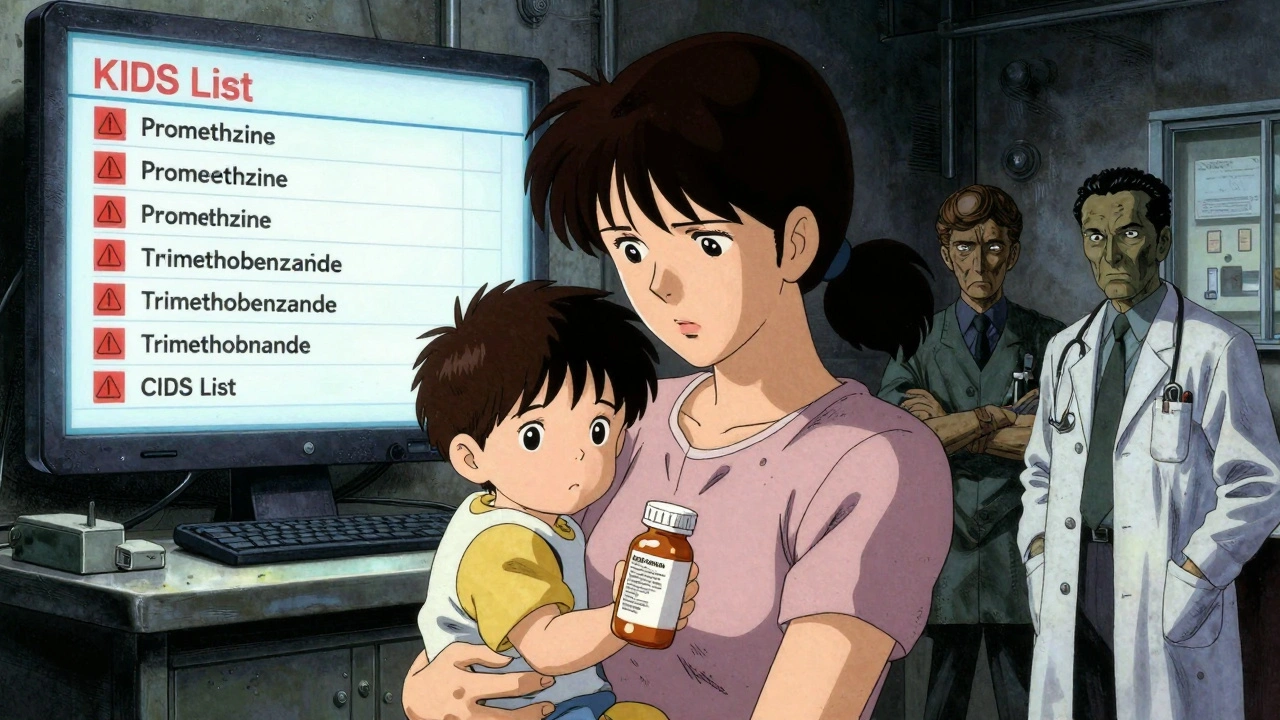
The Pediatric Pharmacy Association created the KIDs List-a living database of drugs that are risky for kids. It’s updated quarterly, and the 2025 version includes over 4,100 drugs with safety concerns. Some entries are clear-cut:- Promethazine (a generic antihistamine): Avoid under age 2. Can cause breathing to stop. Even in older kids, it’s a caution.
- Trimethobenzamide (a nausea drug): Avoid in all patients under 18. Can cause severe muscle spasms.
- Linaclotide (a laxative): Use caution under age 2. Risk of fatal dehydration.
- Guaifenesin (an expectorant): Avoid under age 4. No proven benefit, high risk of side effects.
Off-Label Use: The Silent Epidemic
About 40% of all pediatric prescriptions are for off-label use-that means the drug hasn’t been officially approved for that age, condition, or dose. And 90% of those prescriptions are for generics. Why? Because manufacturers don’t test generics on kids. It’s expensive. It’s complicated. And there’s little financial incentive. So doctors are left guessing. They use adult dosing charts, adjust by weight, and hope for the best. The result? Medication errors in children are three times more common than in adults. A 2023 study from The Joint Commission found that one in five pediatric medication errors involved wrong dosing of a generic drug. Many of these happen because the label doesn’t say “for children under 12” or “do not use in infants.” And here’s the kicker: 60% of generic drugs lack pediatric dosing info. Only 35% of brand-name drugs do. That’s not a small gap. That’s a chasm.Formulation Matters More Than You Think
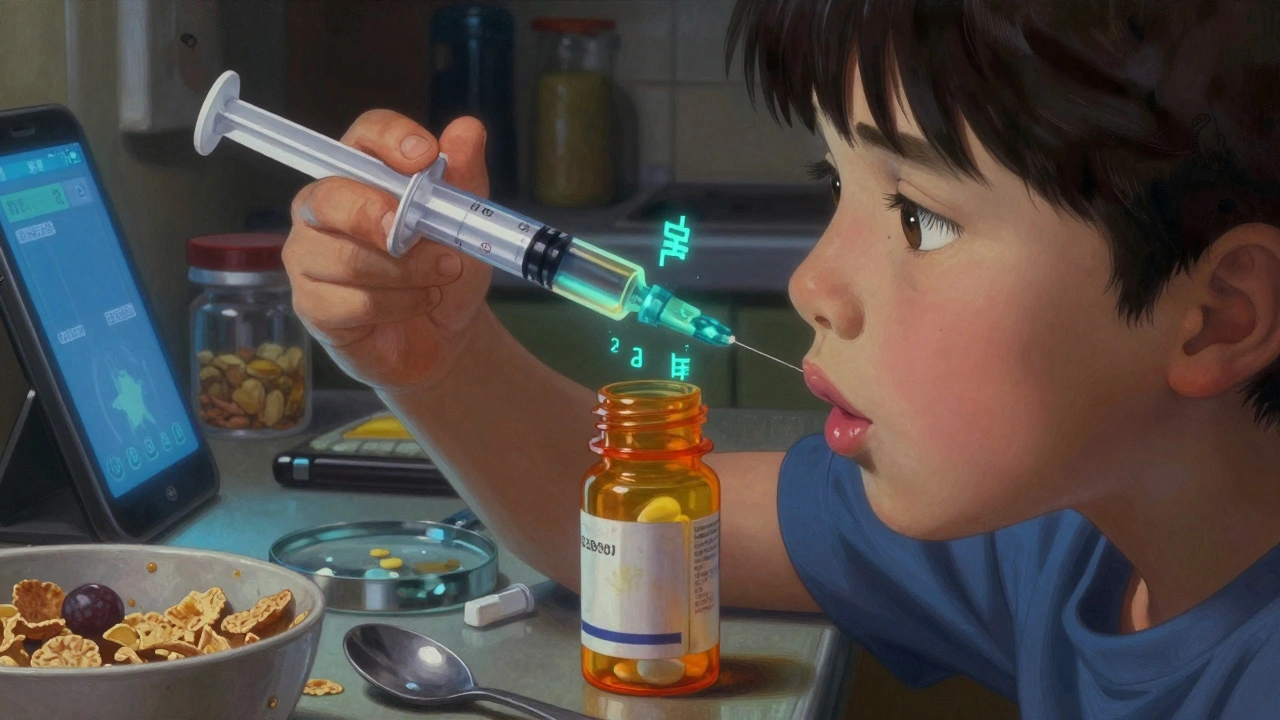
A pill is a pill, right? Not when it’s for a baby. Liquid formulations are the biggest source of errors. One study found that 37% of pediatric medication mistakes involve liquids. Why? Because parents use teaspoons, tablespoons, or even eye droppers. They don’t have oral syringes. They guess. A 10-mL dose of amoxicillin might be labeled as 25 mg/mL. But a generic version might be 40 mg/mL. If a parent doesn’t check the concentration, they could give 60% more than intended. That’s not a typo. That’s a life-threatening overdose. Even the shape and color matter. One parent told their child the medicine was “blue pills.” When the pharmacy switched to a generic with a different color, the child refused to take it. The parent didn’t realize it was the same drug. They thought it was fake. They stopped giving it. The infection returned.
What Doctors and Pharmacies Can Do
Healthcare providers have tools to help. The 5 Rights of medication safety-right patient, right drug, right dose, right route, right time-are the baseline. But for kids, you need three more:- Right concentration-Always check the strength (mg/mL).
- Right device-Use oral syringes, not spoons.
- Right caregiver education-Show parents how to measure. Don’t assume they know.
What Parents Should Do
You don’t need to be a doctor to keep your child safe. Here’s what you can do:- Always ask: “Is this generic version safe for my child’s age?”
- Check the label for age restrictions. If it doesn’t say, ask.
- Use only pediatric-specific formulations. Never give adult medicine to a child.
- Measure with an oral syringe. Not a spoon. Not a cap. A syringe.
- Keep a current list of all medications-including vitamins and OTC drugs.
- Never use someone else’s prescription, even if it’s the same condition.
- Turn on the lights when giving medicine. Do it in daylight, not at 2 a.m. by phone light.
- Ask your pharmacist for the KIDs List if you’re unsure. Many now have printed copies.
The Future Is Changing-Slowly
The FDA’s 2024 guidance now requires generic manufacturers to include pediatric dosing info when it exists. Full compliance is due by December 2025. That’s a step forward. But it’s still not mandatory for every drug. The American Academy of Pediatrics is developing a mobile app that will let doctors instantly check the KIDs List and calculate doses. Beta testing starts in late 2024. That’s promising. Meanwhile, AI tools are being tested to predict safe dosing for generics. Early results show 89% accuracy. That’s not perfect, but it’s better than guessing. The bottom line? Generic drugs aren’t bad. But they’re not always safe for kids. The system was built for adults. Children are still an afterthought. Until that changes, parents and providers must be the ones who speak up. Ask questions. Double-check labels. Don’t assume. Because when it comes to your child’s medicine, safety isn’t optional-it’s everything.Are generic drugs always safe for children?
No. While generic drugs have the same active ingredient as brand-name versions, they often contain different inactive ingredients like dyes, preservatives, or fillers that can cause allergic reactions, breathing problems, or toxicity in children. Some generics aren’t tested for safety in kids at all, and dosing information may be missing or inaccurate.
What is the KIDs List and why does it matter?
The KIDs List (Key Potentially Inappropriate Drugs List) is a constantly updated guide from the Pediatric Pharmacy Association that identifies drugs with known safety risks for children. It includes over 4,100 medications and categorizes them as “avoid” or “caution” based on evidence. It’s critical because many generic drugs used in children aren’t labeled for pediatric use-this list helps doctors and parents avoid dangerous prescriptions.
Can I switch my child’s generic medication without asking the doctor?
Not without checking first. Even small changes in inactive ingredients or concentration can cause side effects or reduce effectiveness. If your child has a condition like epilepsy, thyroid disease, or asthma, switching generics without medical approval can be dangerous. Always ask your doctor if substitution is safe.
Why are liquid medications riskier for kids?
Liquid medications are the leading cause of pediatric dosing errors. Parents often use kitchen spoons or bottle caps, which are inaccurate. Generic versions may have different concentrations (e.g., 25 mg/mL vs. 40 mg/mL), and if the wrong one is used, the child can get too much or too little. Always use an oral syringe and double-check the strength on the label.
What should I do if my child has a reaction after switching to a generic?
Stop giving the medication immediately and contact your pediatrician or go to urgent care. Note the name of the generic drug, the pharmacy, and any symptoms. Reactions can include rash, vomiting, difficulty breathing, or unusual drowsiness. These may be caused by inactive ingredients, not the active drug. Reporting the reaction helps improve safety for other children.
How can I make sure my child’s pharmacy gives the right generic?
Ask your doctor to write “Dispense as Written” on the prescription. This tells the pharmacy not to substitute a generic without your permission. You can also ask the pharmacist to confirm the drug’s pediatric labeling and concentration. Keep a printed copy of the KIDs List handy when picking up prescriptions.
12 Comments
Jack Appleby December 10 2025
Let’s be unequivocally clear: the FDA’s regulatory framework for generics was designed for adult pharmacokinetics, not pediatric physiology. The notion that bioequivalence in plasma concentration equates to clinical equivalence in a developing organism is not merely reductive-it’s dangerously naïve. The inactive ingredients-preservatives, dyes, binders-are not inert fillers; they are pharmacologically active modulators of absorption, metabolism, and immune response in children. Benzocaine-induced methemoglobinemia? That’s not an anomaly-it’s a predictable consequence of regulatory arbitrage. And let’s not pretend the KIDs List is some fringe document-it’s the only evidence-based safeguard we have against pharmaceutical negligence disguised as cost-efficiency.
Moreover, the off-label prescribing epidemic is a direct result of pharmaceutical companies refusing to fund pediatric trials. Why? Because children aren’t profitable markets. They’re liabilities. So we’ve outsourced risk to parents and pediatricians, who are then expected to navigate a minefield of unlabeled, untested, and under-labeled generics with no formal training in pediatric pharmacology. This isn’t healthcare-it’s pharmaceutical roulette.
And yet, the system persists. Because convenience trumps caution. Because ‘generic’ sounds cheaper, and ‘cheaper’ sounds responsible. But when your child’s liver is metabolizing a drug at 3x the rate of an adult’s, and the label says nothing about concentration, responsibility evaporates. We need mandatory pediatric labeling. We need FDA-enforced concentration standardization. And we need to stop treating children as miniature adults with a discount sticker.
This isn’t fearmongering. It’s pharmacology.
- Jack Appleby, PharmD, Pediatric Pharmacoeconomics
Raj Rsvpraj December 11 2025
Ha! Americans always think their system is broken-while India has been safely using generic pediatric formulations for decades! You think your FDA is the gold standard? We have 1.4 billion people using generics-no oral syringes, no pediatric labeling, no ‘KIDs List’-and our infant mortality rate from meds is LOWER than yours! Why? Because we trust our doctors, not your over-litigious, over-regulated, over-medicated culture! Your ‘inactive ingredients’ panic is a luxury of the rich-our children survive on medicines you’d never dare touch! You call it risk-we call it resilience! Stop exporting your fear to the rest of the world!
And yes-I’ve given my 3-year-old generic paracetamol from a local pharmacy with no label in English-and he’s now a cricket champion. Your ‘safety’ is just capitalism dressed in a white coat.
- Raj Rsvpraj, MD, New Delhi
Rebecca Dong December 13 2025
Okay, but what if this is all a BIG PHARMA scam? I mean, think about it-brand-name drugs are WAY more expensive, right? So maybe the FDA and big pharma are secretly working together to scare parents into buying expensive brands… and the ‘inactive ingredients’ thing? Total distraction! What if the real danger is that generics are TOO safe? Like, what if they’re actually better because they’re purer? And what if the ‘dyes’ and ‘preservatives’ are just there to make kids think it’s candy? And what if the KIDs List is just a list of drugs that Big Pharma doesn’t own the patent on? I’ve been reading about this for weeks-there’s a whole underground network of pediatricians who refuse to prescribe anything but brand names because they know the truth…
And why is the FDA only updating labeling in 2025? Coincidence? I think not.
- Rebecca Dong, Former Pediatric Nurse (and truth-seeker)
Michelle Edwards December 14 2025
I just want to say thank you for writing this. As a mom of a 4-year-old with epilepsy, I’ve been terrified every time we switch generics. I’ve had to call the pharmacy three times just to confirm the concentration. I’ve held my breath watching my child take a new pill because I don’t know if the color change means something’s wrong. This post didn’t scare me-it validated me. And honestly? That’s everything.
My advice to other parents: Don’t feel guilty for asking questions. Don’t feel dumb for double-checking. You’re not overreacting-you’re protecting a life. And if your doctor doesn’t take your concerns seriously? Find a new one. Your child deserves that.
You’re not alone.
- Michelle
Sarah Clifford December 16 2025
So like… I just switched my kid’s generic allergy meds and now he’s a zombie. Like, 12-hour nap zombie. I thought it was the new school. Turns out the generic had a different filler. Now I only buy the brand name. And I’m not even rich. But I’d rather spend $30 extra than have my kid look like a corpse. Also, I use a syringe. Always. Even if it’s 3 a.m. and I’m half-asleep. Because I’m not risking it.
Also, why do all the pills look like they’re from a 90s cartoon? Why can’t they just be blue? Why do they keep changing colors??
- Sarah
Queenie Chan December 18 2025
What fascinates me is how deeply we anthropomorphize medicine-how we assume that if two pills contain the same molecule, they’re functionally identical. But biology isn’t chemistry. It’s context. A child’s gut microbiome isn’t just a smaller version of an adult’s-it’s a dynamic, evolving ecosystem shaped by feeding, antibiotics, and environment. The same inactive ingredient that’s inert in one child could trigger a cascade in another. And we treat this like a manufacturing defect, not a biological variable.
And yet, we still measure drug safety in adults and extrapolate downward. It’s like assuming a Formula 1 engine will run the same in a bicycle-just with less fuel. We’re not just underestimating complexity-we’re ignoring the architecture of development itself.
What if the real problem isn’t generics? It’s that we’ve never built a pediatric pharmacology framework that’s independent of adult models? We’ve been retrofitting adult science onto children, then blaming the tools when they fail.
- Queenie
Stephanie Maillet December 19 2025
There’s a quiet tragedy here: we’ve turned medical care into a transaction, and children into cost centers. We measure safety not by outcomes, but by compliance. We reward efficiency over individuality. And in doing so, we’ve normalized the idea that a child’s body is a variable to be optimized-not a sacred, fragile system to be honored.
Generics aren’t inherently evil. But the system that allows them to be prescribed without pediatric validation? That’s the real disease.
What if, instead of asking ‘Is this safe?’, we asked ‘Does this respect the child’s biology?’
What if we stopped asking ‘Can we make it cheaper?’ and started asking ‘Should we?’
- Stephanie
Doris Lee December 20 2025
I just want to say I’m so glad someone finally said this. My daughter had a rash after switching to a generic antibiotic. We thought it was a virus. Took three days to realize it was the preservative. Now I always check the label. Always use the syringe. Always ask. And I tell every mom I know. It’s not about being paranoid-it’s about being prepared. You’ve got this. And you’re not alone.
- Doris
Kaitlynn nail December 22 2025
It’s not the drug. It’s the mindset. We treat kids like fragile glass figurines, but we give them adult-sized decisions. The real issue? We don’t trust parents to think. We give them a pill and a pamphlet and call it care. But care isn’t a label. It’s a conversation.
- Kaitlynn
Aileen Ferris December 22 2025
wait… so generic drugs r dangerous for kids? i thought they were just cheaper? like… i just gave my lil one the generic cough syrup and now im paranoid. also, why do all the labels look the same? like… how do u even tell the diff? lol
- aileen
Regan Mears December 24 2025
My daughter’s pediatrician wrote ‘Dispense as Written’ on her levothyroxine script last year. We switched pharmacies and the new one tried to substitute. I had to call the doctor, then the pharmacy, then the insurance company. It took three days. But she didn’t get the wrong dose. And that’s the point.
This isn’t about brand loyalty. It’s about precision. In pediatrics, 0.5 mL can mean the difference between treatment and toxicity. We need to treat medication like surgery-not shopping.
- Regan
Ben Greening December 26 2025
While the concerns raised are valid, the data on pediatric medication errors is not uniformly distributed. Many countries with robust primary care systems and pharmacist-led medication reviews report significantly lower error rates, regardless of generic use. The issue may be less about the drugs themselves and more about the fragmentation of care, lack of standardized dosing protocols, and insufficient provider education in pediatric pharmacology. A systemic solution-rather than a product-specific one-may yield broader, more sustainable outcomes.
- Ben