When a brand-name drug’s patent expires, you’d expect generic versions to flood the market right away-cheaper, just as effective, and available to millions. But that’s not what usually happens. Instead, there’s often a long wait. Why? Because of a little-known rule called 180-day exclusivity, a legal tool created in 1984 under the Hatch-Waxman Act that’s meant to speed up generics-but often does the opposite.
How 180-Day Exclusivity Works
The Hatch-Waxman Act was designed to balance two goals: protect innovation by giving drugmakers time to recoup R&D costs, and get affordable generics to patients quickly. One of its most powerful tools is the 180-day exclusivity period. It doesn’t apply to every generic drug. It only kicks in when a company files an Abbreviated New Drug Application (ANDA) with a Paragraph IV certification. That’s a legal notice saying: "This patent is invalid, or we don’t infringe it." If that first company wins its patent challenge-either in court or by getting the patent owner to back down-the FDA can’t approve any other generic version for 180 days. That’s the exclusivity. It’s not a reward for being first to submit paperwork. It’s a reward for being first to challenge a patent successfully. And it’s worth millions. For a blockbuster drug like a cholesterol pill or diabetes treatment, that 180-day window can mean over $1 billion in sales before competitors even get to market.When Does the Clock Start?
The 180-day period doesn’t start when the FDA approves the generic. It doesn’t even start when the court rules. It starts on the earliest of two events: either the date the generic drug hits the market for the first time, or the date a court decides the patent is invalid or not infringed. That’s important. If the company gets the court win but doesn’t launch the drug right away, the clock still starts. And once it starts, the exclusivity period runs-even if the company sits on the product for months.Why This System Breaks Down
Here’s the catch: the system assumes the first applicant will rush to market. But in reality, many don’t. Some companies delay launching the drug for years, waiting for litigation to drag on. Others make deals with the brand-name company to postpone entry in exchange for a share of profits. These are called "pay-for-delay" agreements, and they’re legal-though controversial. The result? Patients wait years longer than they should. The 180-day exclusivity, meant to speed up competition, becomes a tool to block it. Take buprenorphine and naloxone sublingual film, a drug used to treat opioid addiction. In 2018, the FDA issued a clarification that made it clear: if the first generic applicant doesn’t start selling the drug within 75 days of winning a court decision or after the patent expires, they lose their exclusivity. But even with that rule, some companies still hold off. Why? Because if they delay, they can keep other generics out of the market for years. The FDA’s own data shows that in some cases, exclusivity has lasted over five years-not 180 days.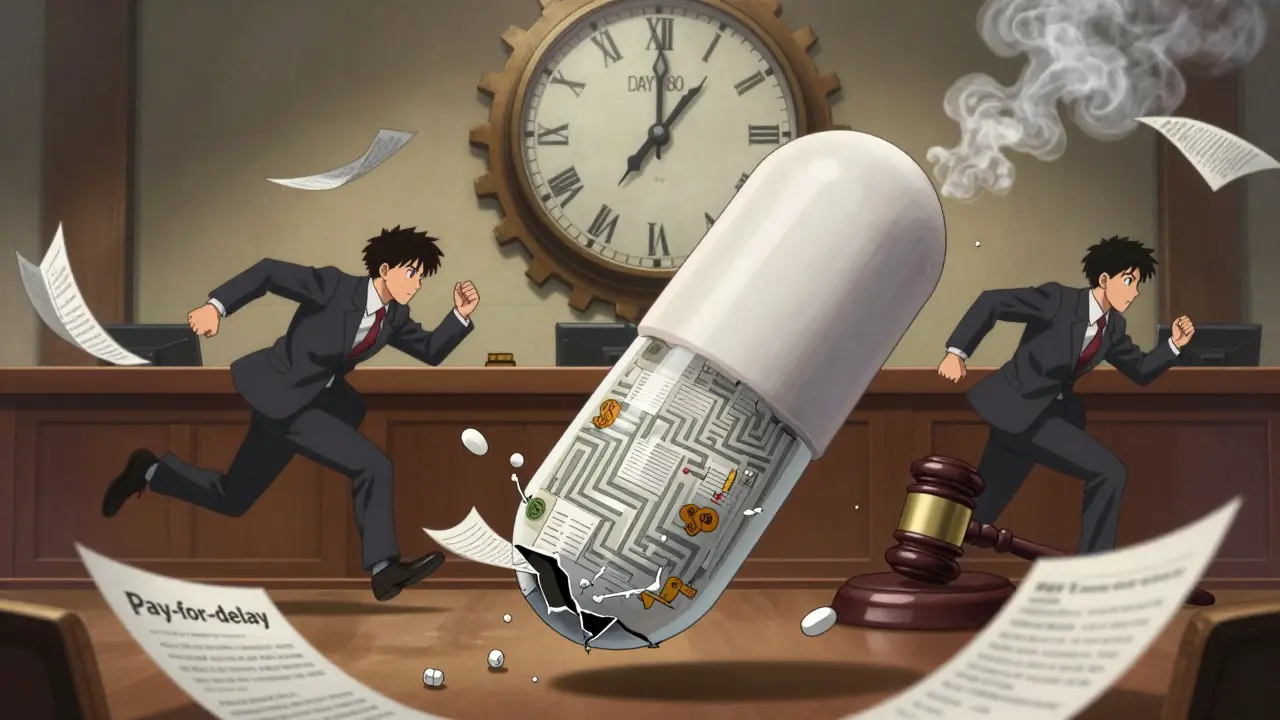
Who Gets Left Out?
Only one company gets the 180-day window. Even if three companies file identical Paragraph IV certifications on the same day, only the one the FDA deems "first" gets the exclusivity. That creates a race-not for patient access, but for legal advantage. Companies hire teams of lawyers and patent experts just to be first. Some even submit "tentative" ANDAs months in advance, hoping to be first if the patent expires early. And what about the other companies? They’re stuck. They can’t enter the market until the exclusivity period ends. But if the first applicant delays, they wait even longer. The FDA estimates that in 2021, over 30% of drugs with 180-day exclusivity had no competitor for more than two years after the patent expired. That’s not competition. That’s monopoly.How It Compares to Other Exclusivity Rules
Other types of exclusivity exist. For example, a new chemical compound gets five years of exclusivity before any generic can even apply. A drug with new clinical data gets three years. Pediatric extensions can add six more months. But none of these are designed to encourage patent challenges. They’re just extensions of brand-name protection. The 180-day exclusivity is unique because it’s the only one that requires a legal fight. It’s the only one that gives a reward for breaking a patent. And it’s the only one that can be forfeited if the company doesn’t launch in time. That’s why it’s so powerful-and so risky. A company might spend $10 million on litigation, only to lose the exclusivity because they missed a deadline. Or worse, they win the case but get blocked by a court appeal.
What’s Changing?
The FDA noticed the problem. In March 2022, it proposed a major change: make the exclusivity period start only when the drug is actually sold. Right now, if a company wins a court decision in January 2024 but doesn’t launch until January 2026, the exclusivity period already ran from January 2024 to July 2024. That means other companies could have entered in 2025-but they didn’t, because the system didn’t care about real market entry. The new proposal says: exclusivity lasts 180 days after the first commercial sale. That’s simple. It’s fair. And it matches what Congress originally intended. The FDA also proposed a new rule: if a company launches more than five years before the patent expires, they get 270 days instead of 180. That’s meant to reward early challengers. But critics say it could backfire-giving even more power to the first mover.What This Means for Patients and Prescribers
For patients, this isn’t just about policy. It’s about cost. A drug that costs $1,200 a month as a brand-name product might drop to $30 a month when generics arrive. But if the first generic delays entry for two years, patients pay $72,000 more than they should. Pharmacists see it too. They know when a drug should be available. When it isn’t, they’re stuck explaining why. For prescribers, it means choosing between a drug that’s legally available but priced like a luxury item, or a cheaper alternative that’s not yet on the formulary. It’s not always about clinical need. It’s about access.What’s Next?
The FDA’s proposed changes are still under review. Until they’re finalized, the system stays broken. Companies still game the rules. Patients still pay more. And the promise of Hatch-Waxman-affordable drugs, fast-remains unfulfilled for too many. The 180-day exclusivity rule was never meant to be a loophole. It was meant to be a bridge. But too often, it’s become a wall.What is the 180-day exclusivity period in generic drug approval?
The 180-day exclusivity period is a legal incentive under the Hatch-Waxman Act that gives the first generic drug company to successfully challenge a brand-name drug’s patent the exclusive right to sell its version for 180 days. During this time, the FDA cannot approve any other generic versions of the same drug based on the same patent challenge. This exclusivity starts either when the generic drug is first sold commercially or when a court rules the patent is invalid or not infringed-whichever comes first.
Who qualifies for 180-day exclusivity?
Only the first company to submit a substantially complete Abbreviated New Drug Application (ANDA) with a Paragraph IV certification-that is, a legal claim that a patent is invalid or not infringed-can qualify. If multiple companies file on the same day, the FDA determines which one is "first" based on submission timing and completeness. Even then, the company must successfully win the patent challenge and not forfeit the exclusivity by failing to market the drug within required timeframes.
Can a company lose its 180-day exclusivity?
Yes. Under the Medicare Modernization Act of 2003, a company can lose its exclusivity if it fails to market the drug within 75 days after winning a court decision or after the patent expires. The FDA clarified this rule in 2018, stating that delay without valid legal or manufacturing reasons counts as forfeiture. Companies can also lose exclusivity if they don’t submit a substantially complete ANDA or if they engage in fraudulent filings.
Why do some generic drugs take years to enter the market after a patent expires?
Even though the patent expires, the first generic company may delay launching its product to extend its monopoly. This can happen if the company negotiates a "pay-for-delay" deal with the brand-name manufacturer, or if it waits for ongoing litigation to resolve. Because the exclusivity clock starts at the first court win or commercial sale-not when the patent expires-companies can legally sit on their product for years, blocking competitors. The FDA estimates that in some cases, this delay has lasted over five years.
How does 180-day exclusivity differ from other types of drug exclusivity?
Other exclusivities, like 5-year new chemical entity exclusivity or 3-year exclusivity for new clinical data, prevent generic applications from being filed at all. The 180-day exclusivity is different: it allows generics to apply, but blocks approval of competing generics for 180 days after the first successful patent challenge. It’s the only exclusivity tied to litigation, and the only one that rewards challenging patents rather than protecting them.
What is the FDA proposing to fix the 180-day exclusivity system?
In March 2022, the FDA proposed a major change: the 180-day exclusivity period should begin only when the first generic drug is actually sold, not when a court rules or when the patent expires. This would prevent companies from sitting on their product for years while blocking competitors. The proposal also suggests extending the exclusivity to 270 days if the drug is launched more than five years before the patent expires, to reward early challengers. These changes aim to ensure exclusivity lasts 180 days, not five years.
12 Comments
Milad Jawabra March 6 2026
This is such a crock. Companies are literally holding drugs hostage for YEARS while patients suffer. The FDA needs to stop playing nice and just revoke exclusivity the second they smell a delay. I don't care if they have 'legal reasons'-if you're not selling, you're not helping. Let the next guy in.
Also, pay-for-delay? That's just corporate bribery with a law degree. Someone needs to jail these CEOs.
Lebogang kekana March 7 2026
I live in South Africa and I’ve seen this firsthand. A lifesaving HIV med sat off-market for 3 years because the first generic company ‘waited for the right time.’ Meanwhile, people died because they couldn’t afford the brand. This isn’t innovation-it’s exploitation with a PowerPoint presentation.
Someone needs to burn this system down.
Justin Rodriguez March 8 2026
The FDA’s proposed change to tie exclusivity to actual market entry is the only logical fix. The current system incentivizes delay, not competition. If the clock starts when the drug hits shelves, not when a court says ‘maybe,’ then companies have to act.
Also, the 270-day extension for early challengers is smart-rewarding proactive litigation, not passive waiting. But enforcement will be key. The FDA needs teeth.
Raman Kapri March 8 2026
You're all missing the point. This system was designed to encourage patent challenges, not to guarantee cheap drugs. If companies want to delay, that's their right under the law. The real problem is that people expect pharmaceuticals to be cheap. They're not. Innovation costs money.
Stop pretending this is about ethics. It's about economics. And the market will correct itself-eventually.
Tildi Fletes March 10 2026
The structural flaw lies in the ambiguity of 'first to file' determinations. The FDA’s criteria for adjudicating simultaneous ANDA submissions are opaque, inconsistent, and subject to regulatory capture.
Moreover, the 75-day market-entry window lacks objective, verifiable benchmarks. Without mandatory public disclosures of manufacturing readiness, the rule is unenforceable. A regulatory audit trail is necessary.
Siri Elena March 11 2026
Oh honey, let me get this straight-some billionaire in a suit gets to sit on a drug for five years because he ‘won’ a lawsuit? And we call this capitalism?
Meanwhile, my grandma is choosing between insulin and her heating bill.
Can we please stop pretending this isn’t a moral failure dressed up in legalese?
RacRac Rachel March 11 2026
I’m so proud of how far we’ve come in healthcare transparency! 🙌
Even though the system is broken, the fact that we’re talking about this-really talking-is a win. The FDA’s proposal? Honestly? A step in the right direction.
Let’s keep pushing. Every voice matters. Every patient matters. 💙
Jane Ryan Ryder March 11 2026
Americans think they deserve free medicine. Newsflash: it costs billions to develop. If you want cheap drugs, move to India. Or stop being lazy and work harder.
Callum Duffy March 12 2026
The regulatory architecture of Hatch-Waxman was elegant in its original conception. The unintended consequence of strategic delay, however, reveals a systemic vulnerability in incentive alignment.
It is not the existence of exclusivity that is problematic, but its temporal anchoring to legal outcomes rather than commercial ones. The FDA’s proposal, though imperfect, represents a necessary recalibration toward market reality.
Chris Beckman March 14 2026
i think the real issue is that big pharma is just too rich and powerful. like, why do we let them do this? they get tax breaks, patent extensions, and now this?
also, why is the fda even allowed to have this rule? it’s like they’re in cahoots. someone should sue them. or at least tweet about it.
Levi Viloria March 15 2026
In Nigeria, we don’t even have access to generics because of import restrictions and corruption. So seeing this U.S.-centric debate feels… odd.
Maybe the real issue isn’t the 180-day rule-it’s that global health equity is an afterthought. The FDA can fix this system all it wants, but if a patient in Lagos can’t get the drug at all, does it even matter?
Zacharia Reda March 16 2026
You know what’s wild? The FDA’s proposal makes sense, but the real power move is how companies game the system by filing multiple ANDAs with minor tweaks just to be 'first.' It’s like a patent troll version of Monopoly.
And yet, nobody talks about how the first generic company often has to re-engineer the whole manufacturing process just to avoid infringement. That’s not laziness-that’s engineering hell.
So maybe we’re blaming the wrong people. The problem isn’t the rule. It’s the entire patent labyrinth.