Drug Interaction Risk Checker
Disclaimer: This tool is for educational purposes only. It does not replace professional medical advice. Always consult your doctor or pharmacist before changing medications.
Imagine this: you pick up a new prescription for high blood pressure. You’ve been taking it perfectly for two weeks. Then, your doctor adds an antibiotic for a minor infection. Within days, you’re dizzy, weak, and end up in the emergency room. Why? The antibiotic changed how your body processed the blood pressure pill. This isn’t a rare horror story. It happens every day.
Drug interactions are not just theoretical risks found in medical textbooks. They are a leading cause of preventable hospitalizations. According to the Food and Drug Administration (FDA), preventable adverse drug reactions account for approximately 7,000 deaths annually in the United States alone. A significant portion of these incidents stems from drug interactions-when two or more medications, supplements, or even foods affect how a medication works in your body.
The goal here isn’t to scare you into stopping your meds. It’s to empower you with practical steps to check for these interactions before they become emergencies. Whether you take one pill or ten, knowing how to navigate this landscape is crucial for your health.
Understanding the Types of Drug Interactions
Most people think of drug interactions as two pills fighting each other. While that’s part of it, the reality is broader. To protect yourself, you need to recognize the four main categories of interactions:
- Drug-Drug Interactions: This is the most common type. One medication changes the way another is absorbed, metabolized, or excreted. For example, combining certain statins with amiodarone can increase the risk of rhabdomyolysis-a serious muscle breakdown condition-by 15-fold, potentially leading to kidney failure.
- Drug-Food Interactions: Foods can alter drug effectiveness. The classic example is grapefruit juice. It inhibits an enzyme called CYP3A4 in your gut, which breaks down many drugs. Eating grapefruit while taking simvastatin can lead to dangerously high levels of the drug in your bloodstream.
- Drug-Supplement Interactions: Just because it’s natural doesn’t mean it’s safe. St. John’s Wort, a popular herbal supplement for depression, speeds up the metabolism of many drugs, rendering birth control pills, blood thinners, and HIV medications less effective.
- Drug-Disease Interactions: Some medications can worsen existing conditions. For instance, non-steroidal anti-inflammatory drugs (NSAIDs) like ibuprofen can aggravate kidney disease or heart failure.
Recognizing these categories helps you ask better questions. It’s not just about "Can I take these together?" It’s about "How does my diet, my supplements, and my health history change the equation?"
The Power of a Comprehensive Medication List
The single biggest gap in patient safety is incomplete information. A 2022 survey by the National Community Pharmacists Association found that 68% of patients do not consistently inform all healthcare providers about all medications they take. If you see multiple doctors, this number gets worse. Patients aged 65 and older often have 4.7 different prescribers but share complete medication information with only 1.2 on average.
To fix this, you need a master list. This isn’t just a note on your fridge. It needs to be comprehensive:
- All Prescription Medications: Include the name, dosage (e.g., 10mg), frequency (e.g., twice daily), and the prescribing doctor.
- Over-the-Counter (OTC) Drugs: Pain relievers, antacids, allergy meds, and sleep aids count. Many people forget that acetaminophen or ibuprofen can interact with blood thinners.
- Herbal Supplements and Vitamins: List everything. Even multivitamins can contain minerals like calcium or iron that bind to antibiotics, preventing absorption.
- Exact Dosages and Frequencies: Knowing you take "Warfarin" isn’t enough. Knowing you take "Warfarin 5mg daily" allows for precise interaction checking.
Bring this list to every appointment. Better yet, bring the actual physical containers. The BeMedWise Program recommends this practice, and a 2018 study in the Journal of General Internal Medicine showed it reduces medication discrepancies by 37%. Doctors can’t prescribe safely if they don’t know what you’re already taking.
Using Online Drug Interaction Checkers Wisely
In the digital age, you have powerful tools at your fingertips. Free online drug interaction checkers are widely available and can provide immediate insights. However, they come with strengths and limitations you must understand.
Tools like the Drugs.com Drug Interactions Checker screen over 24,000 prescription and OTC medications. A 2021 study in the Journal of Medical Internet Research found that Drugs.com identified 92.4% of clinically significant interactions, outperforming some competitors. Another specialized tool, the University of Liverpool’s HIV Drug Interaction Checker, provides color-coded risk assessments based on strong evidence ratings.
Here is how to use them effectively:
- Check for Severity Levels: Look for classifications like "Major," "Moderate," or "Minor." A "Major" interaction usually means avoid combination unless under strict supervision. A "Minor" one might just require monitoring.
- Read the Explanation: Don’t just look at the red flag. Read why the interaction occurs. Is it due to increased bleeding risk? Drowsiness? Reduced efficacy?
- Don’t Panic: These tools are conservative. They may flag theoretical interactions that your specific body won’t experience. This leads to "alert fatigue," where users ignore warnings because there are too many false positives.
Crucially, no online tool replaces professional advice. The FDA cautions that patient-facing tools may not account for individual factors like renal function, age, or genetic variations. Use these checkers as a starting point for conversation with your pharmacist, not as a final diagnosis.
The "One Pharmacy Rule": Simplifying Your Safety Net
Fragmented healthcare delivery is a major contributor to drug interaction risks. A 2020 study by the Agency for Healthcare Research and Quality found that 43% of patients with multiple chronic conditions have incomplete medication records because their providers don’t share electronic records.
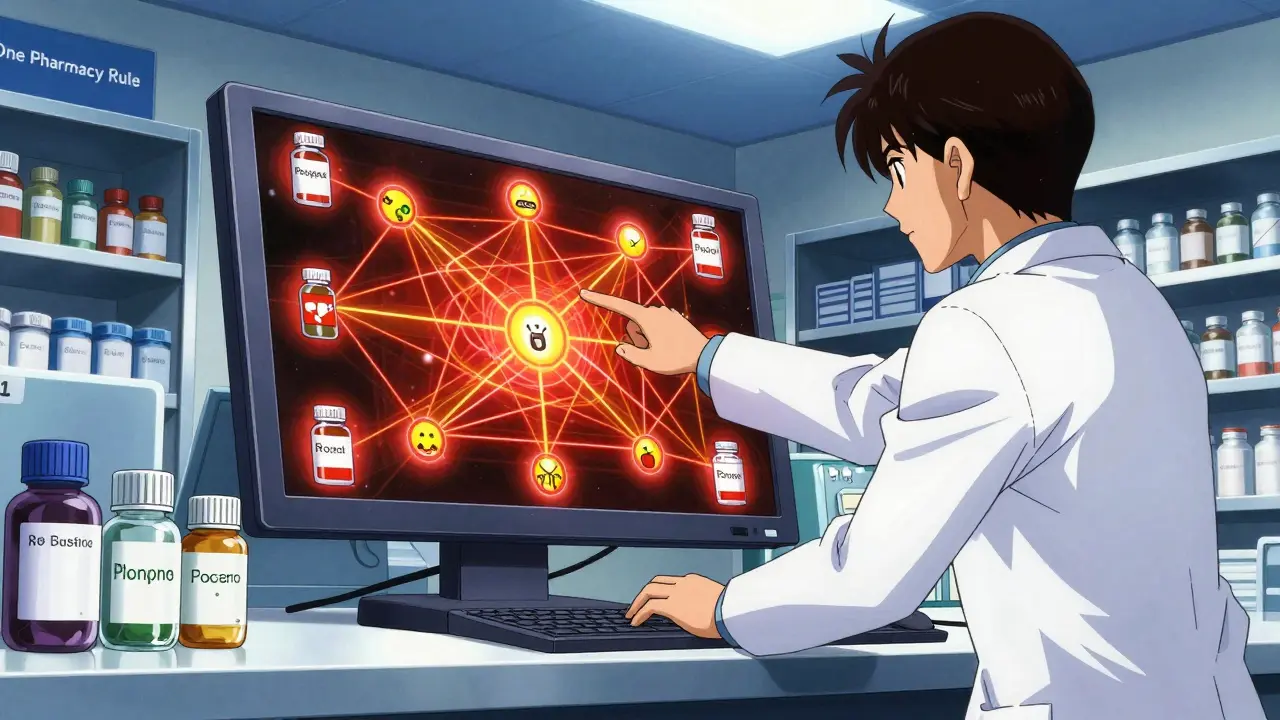
If you use three different pharmacies-one for work insurance, one for Medicare Part D, and one for cash purchases-no single pharmacist has the full picture. Computerized screening software is present in 92% of U.S. pharmacies, yet pharmacists still filled prescriptions for known interacting combinations in 8.3% of cases, largely because the patient used multiple pharmacies.
The solution is simple: Stick to one pharmacy for all your prescriptions. This is known as the "One Pharmacy Rule." A 2021 study in JAMA Internal Medicine involving 22,000 Medicare patients showed that using a single pharmacy reduced serious drug interactions by 31%. When all your data is in one place, the pharmacist’s computer system can automatically flag conflicts across all your medications, including OTCs if you buy them there.
High-Risk Combinations to Watch For
While thousands of interactions exist, a few combinations account for the majority of serious hospitalizations. The American Academy of Family Physicians (AAFP) identifies seven high-risk pairs that cause 63% of serious drug interaction hospitalizations. Knowing these can save your life:
| Combination | Risk Percentage | Potential Consequence |
|---|---|---|
| Warfarin + NSAIDs (Ibuprofen, Naproxen) | 21.7% | Severe internal bleeding |
| SSRIs + MAOIs | 14.3% | Serotonin Syndrome (life-threatening) |
| Digoxin + Clarithromycin | 9.8% | Heart rhythm abnormalities |
| Statins + Fibrates | 7.2% | Muscle damage (Rhabdomyolysis) |
| Sildenafil + Nitrates | 3.1% | Dangerous drop in blood pressure |
If you are on any of these medications, never add a new drug without explicit clearance from your provider. For example, if you are on Warfarin, taking Advil for a headache could trigger a bleed. Always ask for safer alternatives, like Tylenol (acetaminophen), though even that requires caution with liver issues.
Four Critical Questions to Ask Your Provider
Before you start any new medication, whether prescribed or OTC, ask your healthcare provider these four specific questions. They cut through the noise and get to the safety essentials:
- "Can I take this with my current medications?" This prompts them to run a formal interaction check against your full profile.
- "Should I avoid certain foods or beverages?" This catches drug-food interactions like grapefruit juice or alcohol.
- "What are the potential interaction signs I should watch for?" Know what to look for. Is it unusual bruising? Extreme drowsiness? Muscle pain? Early detection prevents ER visits.
- "How will this drug work in my body given my health history?" This addresses drug-disease interactions, ensuring the new med doesn’t worsen diabetes, kidney disease, or hypertension.
These questions shift the dynamic from passive acceptance to active partnership. Providers appreciate engaged patients, and it forces a pause for safety verification.
Building a Personal Medication Passport
Technology fails. Phones die. Electronic records don’t sync. That’s why the Cleveland Clinic recommends maintaining a "medication passport." This is a physical or digital document updated after every healthcare encounter.
Internal data from the Cleveland Clinic shows this practice reduced medication discrepancies by 52% among 15,000 patients tracked from 2019 to 2022. Your passport should include:
- A current list of all meds, dosages, and frequencies.
- Allergies and past adverse reactions.
- Contact info for your primary care physician and pharmacist.
- Notes on recent changes (e.g., "Started Lisinopril on June 1, 2026").
Keep this in your wallet or saved securely on your phone. In an emergency, when you can’t speak, this document gives first responders and ER doctors the critical context they need to avoid harmful interactions.
Future Trends: Precision Medicine and AI
The field of drug interaction management is evolving rapidly. The FDA’s 2023 Drug Interaction Pilot Program is testing machine learning algorithms that analyze electronic health records to predict individual patient risk. Preliminary results show 89% accuracy compared to 72% for traditional rule-based systems.
Furthermore, pharmacogenomics-the study of how your genes affect your response to drugs-is becoming more integrated. The NIH’s Pharmacogenomics Research Network demonstrated in 2022 that including CYP450 enzyme genotype data improved interaction prediction accuracy by 37% for 22 commonly prescribed medications. Soon, your DNA profile might be part of the interaction check, telling us exactly how fast or slow your liver processes specific drugs.
Until then, the responsibility remains largely on you. Technology assists, but it doesn’t replace vigilance. By keeping accurate records, using one pharmacy, asking the right questions, and utilizing reliable checkers, you significantly reduce your risk. Your health is worth the extra five minutes of checking.
How long does it take for a drug interaction to occur?
Timing varies widely. Some interactions, like those affecting blood pressure or heart rhythm, can happen within hours or days. Others, like bone density loss from long-term steroid use, may take months or years. The University of Liverpool notes that 45% of interactions between antiretrovirals and common medications become clinically significant within 24-48 hours of concurrent administration. Always monitor for new symptoms immediately after starting a new medication.
Are herbal supplements safe to mix with prescription drugs?
Not necessarily. Herbal supplements are biologically active and can interact powerfully with prescriptions. For example, St. John’s Wort induces liver enzymes that break down drugs faster, reducing their effectiveness. Ginkgo biloba can increase bleeding risk when taken with blood thinners like Warfarin. Always treat supplements as medications and disclose their use to your healthcare provider.
Why is using one pharmacy so important for safety?
Using one pharmacy ensures that all your prescription data is centralized in one computer system. This allows the pharmacist’s software to automatically screen for interactions across all your medications. Studies show that using multiple pharmacies leads to fragmented records, increasing the risk of missed interactions by up to 31%. Centralization enables comprehensive screening that split usage prevents.
Can food really interfere with my medications?
Yes. Certain foods contain compounds that inhibit or induce liver enzymes responsible for drug metabolism. Grapefruit juice is the most famous example, blocking CYP3A4 enzymes and causing dangerous spikes in drug levels for statins and some blood pressure meds. Dairy products can bind to tetracycline antibiotics, preventing absorption. Always ask your pharmacist if your specific medication has dietary restrictions.
What should I do if I suspect a drug interaction?
Do not stop taking your medication abruptly, as this can cause withdrawal or rebound effects. Instead, contact your pharmacist or doctor immediately. Describe your new symptoms and when they started relative to starting the new drug. They can advise whether you need to adjust doses, switch medications, or seek urgent care. Keep a record of all symptoms to share with your provider.