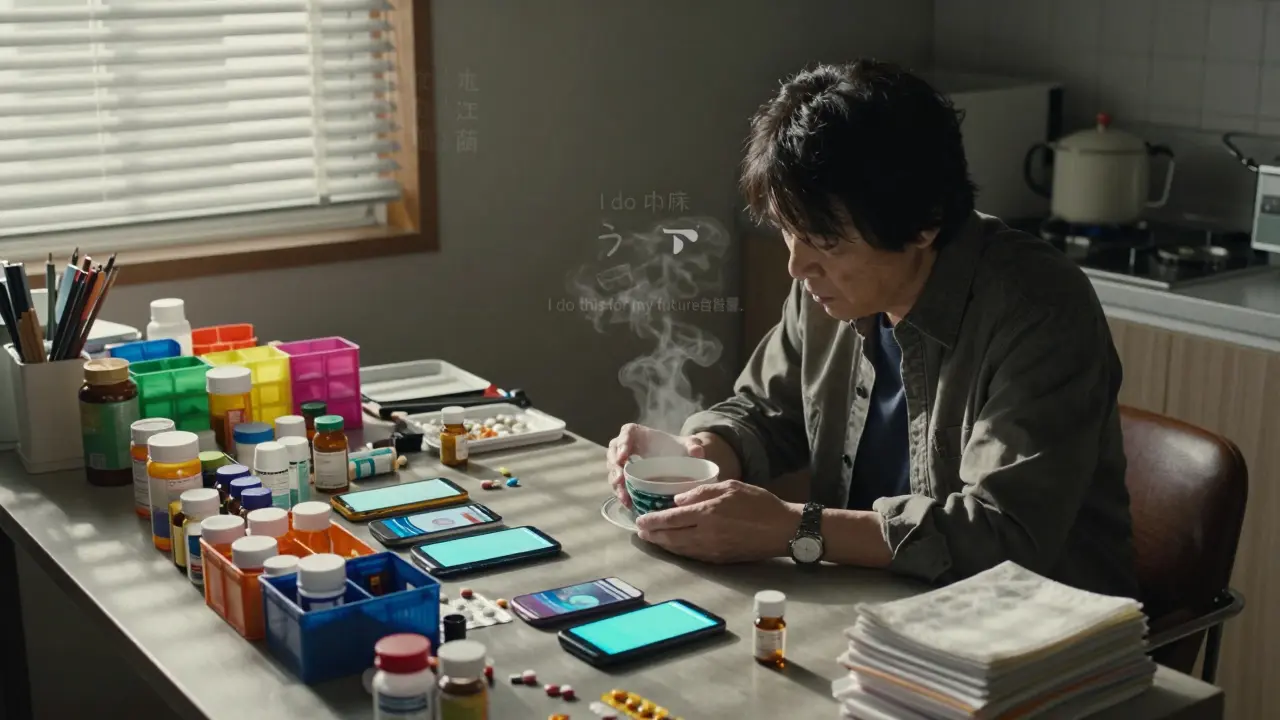
Taking medication every day for years isn’t just a habit-it’s a lifeline. But for many people with chronic conditions like high blood pressure, diabetes, or rheumatoid arthritis, staying on track becomes harder over time. The pills don’t disappear. The symptoms don’t always remind you they’re there. And soon, skipping a dose feels like no big deal. Until it is.
Here’s the hard truth: medication adherence is one of the biggest silent failures in healthcare. The CDC says poor adherence costs the U.S. health system between $100 billion and $300 billion a year. That’s not just money-it’s preventable hospital visits, worsening conditions, and even early deaths. The good news? There are proven ways to fight back. Not with willpower alone, but with real, research-backed coping strategies that work in real life.
Why Do People Stop Taking Their Meds?
It’s not laziness. It’s not stupidity. It’s complexity.
Imagine you’re on five different pills, each with its own schedule. One at breakfast, one at lunch, one at night, one with food, one without. One costs $200 a month. One gives you nausea. One you can’t remember why you’re taking anymore. Add in work, kids, aging parents, and stress-and suddenly, forgetting isn’t a mistake. It’s survival.
Studies show the biggest reasons people skip doses:
- Too many pills, too many times a day
- Cost-especially when insurance doesn’t cover generics
- Side effects that feel worse than the disease
- Feeling fine, so the meds seem unnecessary
- Not understanding why the drug matters
And here’s what most doctors don’t talk about: emotional fatigue. Living with a chronic illness means constant reminders you’re not “normal.” Over time, that wears you down. You start avoiding the meds not because you forget, but because you’re tired of being defined by them.
The Five Coping Strategies That Actually Work
A 2022 review of 15 studies across multiple chronic conditions found five main ways people cope-and only some help. Not all coping is created equal.
1. Problem-Solving / Active Coping (Most Effective)
This is the strategy that works best. 78% of studies showed a strong link between active problem-solving and better adherence. What does this look like?
- Setting phone alarms for each dose-not just one, but multiple backups
- Using a pill organizer with AM/PM slots and color-coded labels
- Writing down why each pill matters: “This lowers my stroke risk” or “This keeps my joints from locking up”
- Calling your pharmacist to ask: “Can I switch to a combo pill?” or “Is there a cheaper generic?”
- Planning ahead: If you’re traveling, you call ahead to refill early
People who use this strategy don’t wait for a crisis. They build systems. They treat medication like brushing your teeth-not a chore, but part of the daily routine.
2. Emotion-Focused Coping (Second Best)
When problem-solving isn’t enough, emotional coping steps in. 69% of studies found this helpful. This isn’t about denial. It’s about managing the emotional weight.
- Journaling how you feel after taking your meds-“I felt calmer today” or “My knee didn’t ache as much”
- Using distraction techniques: listening to music while taking pills, pairing meds with a favorite tea
- Self-encouragement: Saying out loud, “I’m doing this for my future self”
- Connecting with others who get it-online groups, local support circles
In one rheumatoid arthritis study, patients who used self-encouragement and distraction had significantly higher adherence. They didn’t just take pills-they turned the act into a moment of self-care.
3. Seeking Understanding
Knowledge reduces fear. When people truly understand why their meds matter, adherence goes up. This isn’t about reading a pamphlet. It’s about asking questions.
- “What happens if I skip this for a week?”
- “Is there a cheaper version?”
- “Can I take this with my coffee?”
Patients who asked these kinds of questions were more likely to stick with their regimen. Knowledge isn’t power-it’s peace of mind.
4. Support Seeking
People don’t fail because they’re weak. They fail because they’re isolated.
Those who reached out-whether to family, pharmacists, or care teams-had better outcomes. Team-based care models that include pharmacists, social workers, and nurses boost adherence to 89% after 12 months. That’s compared to 74% without it.
One simple change: a pharmacist calling to check in. Not to nag. Just to say, “How’s the new pill schedule working?” That’s all it takes to rebuild trust.
5. Problem Avoidance (The Trap)
Here’s the dangerous one. 50% of studies found this strategy hurt adherence. Avoiding the problem sounds like:
- “I’ll take it tomorrow.”
- “I don’t feel sick, so I don’t need it.”
- “I’ll just stop if it makes me feel weird.”
It’s not laziness. It’s fear. Fear of side effects. Fear of dependency. Fear of being “that sick person.” But avoidance doesn’t make the problem go away. It just makes it worse.

What Really Moves the Needle?
Here’s what works in real life, based on real data:
- Combination pills: If you’re on three separate meds for blood pressure, ask if they can be combined into one pill. One study showed this cut pill burden by 40%.
- Generic substitution: Switching to generics saved patients an average of $80 a month. That’s not pocket change.
- Pharmacist-led coaching: A pharmacist who spends 15 minutes explaining your regimen-not just handing out pills-doubles adherence rates.
- Text reminders: Simple, personalized texts (“Don’t forget your diabetes pill today!”) improved adherence by 22% in a 2023 trial.
- Cost assistance: Programs like RxAssist.org help people get free or low-cost meds. If you’re paying over $50/month out of pocket, you’re eligible.
And here’s something surprising: women are 4.5 times more likely to stick with their meds than men. Why? Research suggests women are more likely to seek support, ask questions, and prioritize health routines. It’s not about gender-it’s about access to tools and social support.
What Doesn’t Work
Don’t waste time on these:
- Shaming yourself for forgetting
- Waiting until you feel sick to take your meds
- Trying to “tough it out” without help
- Using generic pill organizers without labels (you’ll forget which is which)
- Assuming your doctor knows everything about your daily struggles
Healthcare systems are built for acute care, not long-term management. You have to become your own advocate.

How to Start Today
You don’t need to fix everything at once. Pick one thing:
- Write down the one reason you take each pill. Keep it on your phone or fridge.
- Set three alarms on your phone: one for each daily dose. Name them: “Blood pressure,” “Joint pain,” “Heart health.”
- Call your pharmacy. Ask: “Can I get a 90-day supply?” or “Is there a cheaper version?”
- Find one person you can talk to-friend, family, online group-about how hard this is.
- Next time you see your doctor, say: “I’m trying to stay on track. What’s one thing I can simplify?”
Progress isn’t about perfect adherence. It’s about showing up, even when it’s hard. One pill at a time.
When to Ask for Help
If you’ve tried these strategies and still struggle, it’s time to ask for more support. You’re not failing. The system might not be designed for you.
- Ask for a pharmacist consult
- Request a social worker to help with cost or transportation
- Ask your doctor about medication therapy management (MTM) services
- Use free apps like Medisafe or MyTherapy to track doses and get reminders
There’s no shame in needing help. The goal isn’t to be perfect. It’s to stay healthy.
Why do I still forget my pills even though I set reminders?
Reminders help, but they don’t fix the deeper issue: emotional fatigue or confusion about why the pill matters. If you’re still forgetting, try pairing your dose with a daily habit-like brushing your teeth or making coffee. Also, ask your pharmacist if you can switch to a once-daily pill or a combination product. Sometimes, the problem isn’t memory-it’s complexity.
Can I stop my meds if I feel fine?
No. Many chronic medications work silently-like blood pressure or cholesterol drugs. You won’t “feel” them working, but they’re preventing damage. Stopping them suddenly can lead to serious complications like stroke, heart attack, or organ damage. Always talk to your doctor before making changes. They can help you find a safer way to reduce side effects or simplify your regimen.
Are generics as good as brand-name drugs?
Yes. The FDA requires generics to have the same active ingredients, strength, and effectiveness as brand-name drugs. The only differences are in inactive ingredients (like fillers) and cost. Generics can save you 80% or more. If your insurance won’t cover the generic, ask your pharmacist to submit a prior authorization. Many insurers will approve it with a simple note from your doctor.
How do I know if my coping strategy is working?
Track your adherence for 30 days. Use a simple checklist: Did you take your pills as prescribed? If you missed more than two doses, your strategy needs adjusting. Also, notice how you feel emotionally. Are you less stressed about meds? Do you feel more in control? If yes, you’re on the right path. If not, try combining strategies-like problem-solving + emotional support.
What if I can’t afford my meds?
You’re not alone. Programs like RxAssist.org, NeedyMeds, and Patient Assistance Programs from drug manufacturers offer free or low-cost medications. Your pharmacist can help you apply. Also, ask your doctor about switching to a cheaper alternative or a 90-day supply, which often reduces copays. Never skip doses because of cost-there are always options.
13 Comments
Michael Page February 14 2026
It’s not about willpower. It’s about systems. The body doesn’t care if you’re tired, stressed, or overwhelmed. It just responds to patterns. If you treat medication like brushing your teeth-same time, same place, same ritual-it stops being a mental burden and becomes just part of being alive. No moralizing. No guilt. Just biology meeting routine.
Mandeep Singh February 15 2026
You people are missing the entire point. This isn’t about ‘coping strategies’-it’s about systemic failure. Why should a diabetic in rural India have to choose between insulin and rent? Why are we celebrating people who remember to take their pills like it’s some kind of Olympic sport? The problem isn’t the patient. The problem is a healthcare system that treats chronic illness like a personal failure instead of a public emergency. Stop praising compliance. Start demanding justice.
Betty Kirby February 16 2026
Oh honey. You think alarms and pill organizers are the answer? Please. I’ve seen too many people with six different bottles lined up like a pharmacy exhibit, all while their depression goes untreated and their sleep is trash. Medication adherence isn’t a logistics problem-it’s a psychological one. You can’t out-organize trauma. If you’re taking pills to feel less broken, you’re already losing. The real fix? Stop pretending your worth is tied to how well you swallow chemicals.
Josiah Demara February 17 2026
Let’s be brutally honest: 80% of people who ‘struggle’ with adherence are just lazy. They don’t want to be reminded they’re sick. They’d rather die quietly than admit they need help. The data doesn’t lie-people who take their meds consistently live longer, healthier lives. If you can’t be bothered to set an alarm, maybe your life isn’t worth saving. And yes, I said that out loud.
Chiruvella Pardha Krishna February 18 2026
There is a quiet dignity in continuing to take the pills when no one is watching. Not because you believe in systems, but because you still believe in yourself-even when the world has stopped believing in you. The pill doesn’t care if you cried yesterday. It only cares if you show up. And that, more than any study or statistic, is the real act of resistance.
Joe Grushkin February 19 2026
One pill at a time? Cute. That’s the kind of empty motivational nonsense that gets sold on Instagram. Real life doesn’t have hashtags. You don’t get a trophy for not dying. If your medication costs more than your rent, you’re not failing-you’re being exploited. Stop pretending this is about personal responsibility. It’s about capitalism failing people who need it most.
Kapil Verma February 21 2026
Why are we talking about this like it’s a Western problem? In India, we don’t have apps or pharmacists checking in. We have mothers who wake up at 4 a.m. to make sure their son takes his pills. We have grandfathers who walk 5 kilometers to the clinic because the bus doesn’t run. This isn’t about ‘coping strategies.’ It’s about survival. Stop overcomplicating it with your American therapy jargon.
Kaye Alcaraz February 21 2026
You’re doing better than you think. Every time you take that pill, even if you forgot yesterday, even if you cried while swallowing it-you’re choosing yourself. That’s courage. Not perfection. Not consistency. Just showing up. And if you need help, ask. You don’t have to be strong alone. We’re all in this together.
Sarah Barrett February 21 2026
There’s something deeply human about the ritual of taking medication. It’s not just chemistry-it’s a daily affirmation: I am still here. I am still trying. Even when the world moves on, even when the symptoms fade, even when no one notices-you are still doing the work. That quiet persistence deserves more than a CDC statistic. It deserves reverence.
Erica Banatao Darilag February 21 2026
i just wanted to say that i missed my pill yesterday and i felt awful about it but then i read this and realized its not about being perfect its about keepin goin. thank you for writing this. its helped me a lot. i still dont have it all figured out but im tryin.
Charlotte Dacre February 22 2026
Oh, so now we’re giving medals to people who don’t forget their pills? Next they’ll award a Pulitzer to the person who remembered to breathe. This isn’t bravery. This is basic hygiene. And if you need a 15-step guide to take a pill, maybe you should’ve stayed in med school.
Esha Pathak February 23 2026
✨ Take your pills with a song ✨
✨ Pair it with your morning chai ✨
✨ Whisper ‘I’m still here’ to the mirror ✨
✨ You’re not broken-you’re becoming ✨
✨ The world needs your stubborn hope ✨
✨ And yes, you’re doing better than you think 💖
Mike Hammer February 24 2026
My dad’s been on 7 meds for 12 years. He forgets sometimes. He gets mad. He hates the cost. But he still does it. Why? Because he remembers what it felt like to be in the hospital. Not the pain. The helplessness. That’s the real motivator. Not alarms. Not apps. Just a memory of how bad it got. Maybe that’s what we’re missing-the story behind the pill.