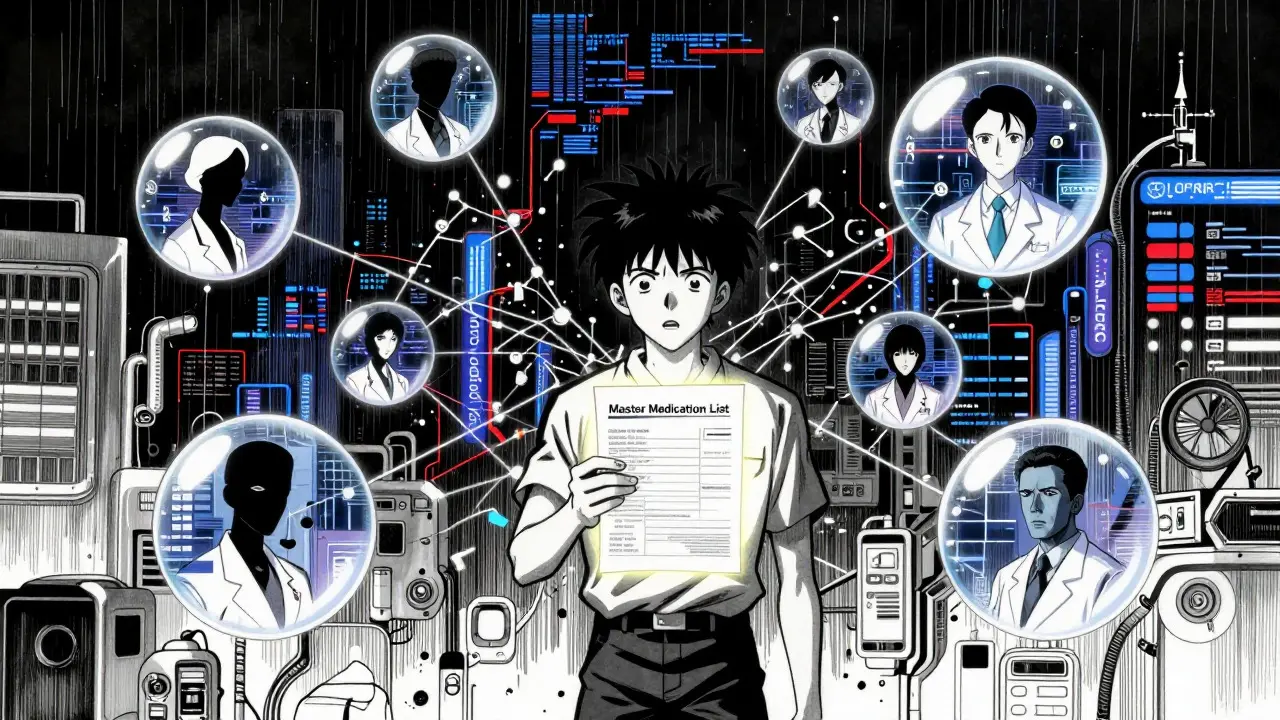
Imagine walking into a specialist’s office, only to find out they just prescribed you a blood thinner. You pause and mention that your cardiologist started you on the exact same type of medication last week. The specialist frowns, checks their system, and realizes neither doctor knew about the other’s prescription. This isn’t a rare glitch; it is a dangerous gap in how our healthcare systems handle information. When you see multiple doctors-your primary care physician, a dermatologist, a cardiologist, and perhaps a mental health professional-the risk of these "prescribing cascades" skyrockets.
You are not just a patient in this scenario; you are the central hub of a complex network. If that network fails to share data effectively, you pay the price in side effects, hospital visits, or worse. The goal here is simple: keep everyone on the same page so your medications work together instead of against each other.
Why do doctors often fail to communicate about my medications?
The main reason is fragmented electronic health records (EHRs). While many hospitals use digital records, different healthcare systems often use incompatible software that does not talk to each other. A study by the NIH found that 68% of patients receiving care from multiple providers experienced at least one medication-related communication breakdown within a year. Additionally, specialists often focus narrowly on their specific organ system without checking the full list of drugs prescribed by other providers, leading to unintended conflicts.
The Hidden Danger of Fragmented Care
We tend to assume that if we have an insurance card and a medical record, everything is connected. It is not. In the United States, medication errors affect approximately 1.5 million people annually, costing billions in additional medical costs. These are not always mistakes made by a tired nurse or a distracted pharmacist. Often, they are systemic failures where no single provider had the complete picture.
Consider the concept of the Circle of Care, which models the flow of information between patients, families, and various healthcare professionals to ensure safe medication management. Research led by Dr. Wendy Gifford at the University of Ottawa highlighted that "coordination of medication information" was historically overlooked. They identified five key activities in medication management: determining need, prescribing, dispensing, administering, and monitoring. Communication must happen seamlessly across all five steps. When it doesn't, the result is what experts call a "near-miss." Studies show that 72% of these near-misses are directly attributable to poor communication between providers.
If you are seeing three or more providers, you are 3.2 times more likely to experience medication regimen conflicts than someone seeing just one. Specialists, who are experts in their narrow fields, initiate 41% of the medications that end up conflicting with existing regimens. They may not know you are taking a supplement from your naturopath or a painkiller from your orthopedist. That is why you cannot rely solely on them to check with each other. You must be the active coordinator.
Building Your Master Medication List
The single most effective tool you can carry is a comprehensive, up-to-date medication list. This is not just a scrap of paper with names scribbled on it. It needs to be structured. According to clinical guidelines from Happier at Home and supported by research from Tulane University, your list must include four critical elements for every single substance you take:
- Name of the medication: Include both brand and generic names if possible.
- Dosage: How much milligrams (mg) or micrograms (mcg)?
- Frequency: Once daily? Twice a day? Only when needed?
- Purpose: Why are you taking it? (e.g., "High blood pressure," "Anxiety").
This might seem tedious, but consistency here reduces medication errors by 37%. Do not forget supplements, over-the-counter pain relievers, and herbal remedies. Many patients assume these are harmless, but St. John’s Wort, for example, can interfere with blood thinners and antidepressants. Your list should also note who prescribed each item. This helps new providers understand the origin of the therapy and makes it easier to contact the original prescriber if questions arise.
Keep this list in your wallet, on your phone, and in a physical binder. Update it immediately after any appointment or pharmacy pickup. If a doctor changes your dose, change it on your list before you leave the office. This creates a single source of truth that you control.
Using the Teach-Back Method
Communication is a two-way street, but doctors are often rushed. To ensure you understood the instructions correctly, use the Teach-Back Method, a communication technique where patients repeat back instructions in their own words to confirm understanding. This is not about testing the doctor; it is about protecting yourself. After a provider gives you new instructions, say something like, "Just to make sure I got this right, I will take this pill with food every morning, correct?"
The Agency for Healthcare Research and Quality (AHRQ) has validated that this method reduces misunderstandings by 45%. It forces a moment of clarity in the conversation. If the doctor says, "Yes," and you repeat it back as "No food, empty stomach," the discrepancy is caught instantly. It also signals to the provider that you are engaged and careful, which often prompts them to be more thorough in their explanation.

The Role of Pharmacists as Safety Nets
Your pharmacist is arguably your most accessible medication expert. Unlike doctors who see you for 15 minutes a few times a year, pharmacists review your entire medication profile every time you pick up a script. Data from Asteroid Health shows that involving pharmacists in the medication management process leads to 32% higher adherence rates and significantly better communication outcomes.
Treat your pharmacist as a co-pilot. Ask them specifically: "Does this new medication interact with anything else on my list?" They have access to powerful interaction-checking software that doctors may not have time to consult during a brief visit. In fact, patients who work closely with clinical pharmacists report 63% higher confidence in their regimens. If you use multiple pharmacies, try to consolidate them into one location. This allows the pharmacist to see the full picture and flag potential issues automatically.
Navigating Electronic Health Records (EHRs)
You might wonder, "Can’t the computers just talk to each other?" Ideally, yes. The 21st Century Cures Act mandated interoperable EHR systems, but reality lags behind policy. A 2023 report found that only 38% of providers can consistently access complete patient medication histories across different healthcare systems. This means your primary care doctor might not see what your specialist ordered if they use different hospital networks.
To bridge this gap, you can request copies of your records. Most health systems now offer patient portals where you can download PDF summaries of your visits and lab results. Bring these printed summaries to new appointments. It is a low-tech solution to a high-tech failure, but it works. It ensures that the provider sitting across from you has the context they need to make safe decisions.
| Strategy | Effectiveness Metric | Key Benefit |
|---|---|---|
| Master Medication List | 37% reduction in errors | Provides a single source of truth for all providers |
| Teach-Back Method | 45% reduction in misunderstandings | Confirms patient comprehension in real-time |
| Pharmacist Consultation | 32% higher adherence | Leverages expert drug-interaction screening |
| Health Journaling | 22% fewer adverse events | Tracks symptoms and side effects for pattern recognition |

Keeping a Health Journal
Medications don't exist in a vacuum; they interact with your body, your mood, and your sleep. A static list tells a doctor what you are taking, but a journal tells them how it is affecting you. The University of California San Francisco found that patients who kept detailed health journals had 22% fewer adverse drug events.
Your journal should track more than just doses. Note any changes in your energy levels, sleep quality, appetite, or mood. Did you start feeling dizzy after adding that new blood pressure med? Did your anxiety improve after the second week of therapy? These subjective experiences are crucial data points. When you bring this journal to an appointment, you shift the conversation from "Are you taking your pills?" to "How is this treatment impacting your life?" This empowers you to advocate for adjustments based on real-world evidence, not just theoretical guidelines.
When to Escalate Concerns
Sometimes, despite your best efforts, things go wrong. If you experience severe side effects, unexpected interactions, or feel that your providers are ignoring your concerns, you need a plan. Know who your primary point of contact is. Usually, this is your Primary Care Physician (PCP), but if your PCP is overwhelmed, consider asking for a referral to a geriatrician (if you are older) or a clinical pharmacist for formal Medication Therapy Management (MTM).
In Accountable Care Organizations (ACOs), there are dedicated care coordinators whose job is to manage exactly these types of complexities. CMS data shows that patients in ACOs experience 27% fewer medication-related hospital readmissions because these teams actively coordinate between specialists. If you are not in an ACO, ask your insurer if they offer a case manager or nurse navigator. These professionals can make the calls to your specialists to clarify discrepancies, saving you the stress of playing phone tag.
Summary of Action Steps
Taking charge of your medication communication is not about becoming a doctor; it is about becoming an informed partner in your care. Start by creating that master list today. Use the teach-back method at your next visit. Build a relationship with your pharmacist. Keep a simple journal of how you feel. These small actions create a safety net that catches errors before they become emergencies. Your health is too important to leave to chance or disconnected computer systems.
What is the Circle of Care model?
The Circle of Care model is a framework developed to visualize and improve the flow of medication information between patients, family members, and all healthcare providers involved in a patient's care. It emphasizes that safe medication management requires coordinated communication across all stages: prescribing, dispensing, administering, and monitoring. By placing the patient at the center, it highlights the need for explicit coordination rather than assuming information is automatically shared.
How often should I update my medication list?
You should update your medication list immediately after any change occurs. This includes starting a new medication, stopping one, changing a dosage, or switching from brand-name to generic. Carry this updated list to every medical appointment, including dental visits and emergency room trips. Consistency is key to preventing errors.
Can my doctors see each other's prescriptions?
Not always. While electronic health records (EHRs) are improving, many healthcare systems use different platforms that do not fully integrate. A 2023 report indicated that only 38% of providers can consistently access complete medication histories across different systems. Therefore, you should never assume your doctors are communicating electronically; always provide your own written list.
Why are pharmacists important in medication communication?
Pharmacists are medication experts who review your entire drug profile for interactions and side effects every time you fill a prescription. Studies show that involving pharmacists leads to 32% higher medication adherence and helps identify potential conflicts that doctors might miss due to time constraints or lack of full history. They serve as a critical safety checkpoint.
What is a prescribing cascade?
A prescribing cascade occurs when a side effect from one medication is mistaken for a new medical condition, leading a doctor to prescribe another medication to treat that side effect. This creates a cycle of increasing polypharmacy without solving the root cause. Clear communication between providers helps prevent these unnecessary and potentially harmful additions to your regimen.