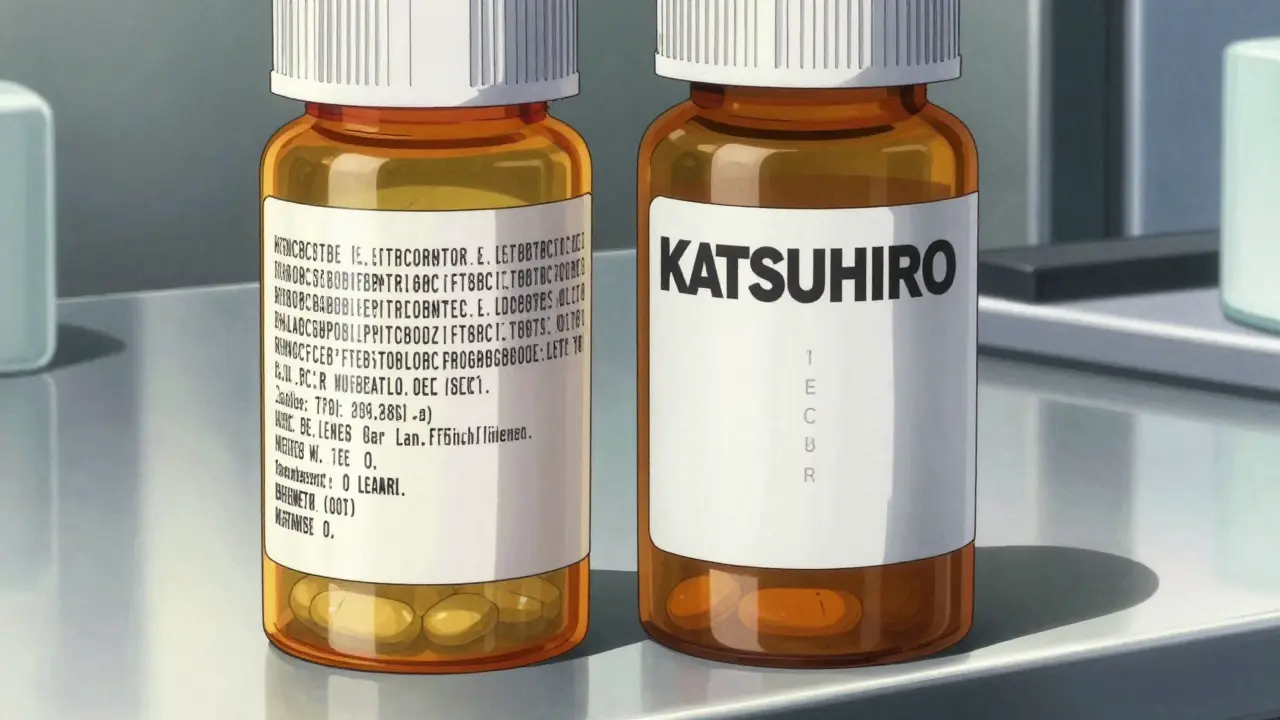
You pick up your refills from a different pharmacy, or maybe you just switched from a local drugstore to a big chain, and you notice something strange. The sticker on your pill bottle looks completely different. The font is bigger, the instructions are phrased differently, or the pharmacy's name is in a different spot. It seems like a small detail, but these layout shifts are more than just a branding choice-they are the result of a fragmented regulatory system in the United States.
The reality is that there is no single, nationwide standard for how a prescription labels layout should look. While you might expect a uniform look across the country, your bottle's appearance depends on which state you're in, which pharmacy software they use, and whether the pharmacist follows voluntary guidelines. This lack of consistency isn't just annoying; it's a genuine safety concern that can lead to dosing mistakes.
The Fragmented Rules of the Game
To understand why your bottle looks the way it does, you have to look at who is actually making the rules. In the U.S., labeling is a tug-of-war between three different levels of authority.
First, there is the FDA is the federal agency responsible for regulating the safety and efficacy of drugs. Interestingly, the FDA's strict rules (like 21 CFR § 201.56) mostly target the professional paperwork that comes with a drug-the detailed scientific data doctors read. When it comes to the actual sticker on your bottle, the FDA's minimum requirement is surprisingly basic: it essentially just needs to say "Rx only" and include your name and dosage.
Then you have the United States Pharmacopeial Convention (USP) is a nonprofit organization that sets public standards for the identity, strength, quality, and purity of medicines. In 2012, they released General Chapter <17>, which is basically a "gold standard" for patient-friendly labels. They suggested using sans-serif fonts like Arial, avoiding all-caps, and using plain language (like "for high blood pressure" instead of "for hypertension"). The problem? These standards are voluntary. A pharmacy can choose to follow them, but they aren't legally forced to.
Finally, there are the state boards of pharmacy. These boards have the real power. For example, the Texas State Board of Pharmacy has its own specific requirements for font size (nothing smaller than ten-point Times Roman) and exactly what pharmacy information must appear. Because there are 47 different state-specific frameworks, a label that is legal in California might not meet the requirements in Texas.
Why Layout Changes Lead to Real-World Mistakes
When a layout changes, your brain has to re-learn where to find the most important information. This is where the danger kicks in. Imagine you've used the same pharmacy for years and you're used to the dosage being in a bold box in the center. If you switch pharmacies and the dose is now tucked into a long sentence at the bottom, it's easy to glance over it.
This isn't just a theoretical worry. Research from the Institute for Safe Medication Practices suggests that medication errors could drop by 30% to 40% if we had a standardized, patient-centered layout. In real life, this looks like a patient taking double their dose of a blood thinner because a new label format made "take 1 tablet twice daily" look like "take 2 tablets daily." When the visual cues we rely on disappear, the risk of a mistake spikes.
| Authority | Focus Area | Influence on Your Bottle | Mandatory? |
|---|---|---|---|
| FDA | Professional Data | Low (Basic requirements) | Yes |
| USP | Patient Experience | Medium (Design best practices) | No (Voluntary) |
| State Boards | Legal Compliance | High (Font, content, layout) | Yes |
The Technical Side: Software and Systems
Beyond the law, the technology behind the counter plays a huge role. There are about a dozen major pharmacy management systems used across the U.S. Each system handles data differently and generates labels using different templates. If a pharmacy chain updates its software or switches providers, the labels might change overnight even if the pharmacy hasn't moved an inch.
This technical fragmentation means that even within one company, you might see variations. Pharmacy technicians often report that customers return to the counter simply because the "look" of their instructions changed, causing them to doubt if they are taking the right medicine. It's a psychological effect: a change in visual presentation often triggers a perceived change in the medication itself.
Moving Toward a Safer Standard
The good news is that the industry is slowly waking up to this problem. The Biden administration's 2022 Patient Safety Action Plan set a goal for 90% of states to adopt standardized labeling by 2026. We're also seeing big players move the needle; CVS Health, for instance, committed to implementing USP <17> standards across its thousands of locations to reduce confusion.
The shift is also moving digital. The medication adherence technology market is booming, with apps that can scan a variable physical label and translate it into a consistent, easy-to-read digital alert on your phone. By removing the "visual noise" of a physical sticker, these tools help patients focus on the only thing that matters: taking the right dose at the right time.
How to Protect Yourself from Label Confusion
Since you can't wait for every state to agree on a font, you have to be your own advocate. If your label looks different than it did last month, don't just assume it's a new design. Stop and verify.
- Ask for Large Print: If you struggle with small text, most pharmacies can provide large-print labels. While not all do it consistently, it's a right you should exercise.
- Verify the "Purpose of Use": Check if the label says what the drug is for (e.g., "For Blood Pressure"). If it doesn't, ask the pharmacist to add it. It's a simple way to prevent taking the wrong medication if you have multiple bottles that look similar.
- Cross-Check the Dose: Compare the new label with your old one. If the wording has changed from "Take one tablet twice a day" to "Take 1 tab BID," ask for a clarification in plain English.
- Request a Digital Copy: If your pharmacy offers an app or email summary, use it. Digital formats are often more consistent and easier to search than a curved sticker on a plastic bottle.
Why does my pharmacy use all capital letters on some labels?
Many older pharmacy systems use all-caps by default. However, the USP recommends using sentence case (initial capitals followed by lowercase) because it is significantly easier for the human eye to process and read quickly, which reduces the chance of a dosing error.
Is there a federal law that says exactly how a label must look?
No. While the FDA mandates certain information (like the patient's name and dose), they do not dictate the layout, font, or design. Those details are left to the individual states and the pharmacies themselves, which is why labels vary so much across the country.
What are USP <17> standards?
USP <17> is a set of voluntary guidelines designed to make labels more patient-friendly. They focus on high-contrast print, non-condensed fonts, and clear, explicit instructions (like using "for high blood pressure" instead of medical jargon like "hypertension").
Can I ask my pharmacist to change my label layout?
Yes. You can request large-print labels or ask the pharmacist to clarify the instructions in a way that is easier for you to understand. Some pharmacies can also provide labels in other languages or accessible formats like Braille.
Does a change in label layout always mean a change in my medication?
Not necessarily. A change often happens because the pharmacy updated its software, switched to a new supplier, or changed its internal branding. However, because layout changes can lead to confusion, you should always double-check the dosage and drug name with your pharmacist whenever the look of the bottle changes.
9 Comments
Kristen O'Neal April 26 2026
It is honestly wild that something as critical as medication dosing is left to a patchwork of state rules and voluntary guidelines. Imagine the chaos if we had this for something like air traffic control. I really hope that 2026 goal for standardized labeling actually happens because the risk of a mistake is just too high for some people to handle alone.
Edwin Perez April 27 2026
Typical government incompetence. They keep the standards fragmented on purpose so you can't easily track what's actually in the bottles. It is all a game to keep people confused and dependent on the system.
Anand Mehra April 28 2026
fragmentation is just a mirror of a broken society no one cares about the user they care about the software license
Majestic Blue Band April 30 2026
It is just so utterly typical of the medical industrial complex to pretend that these "layout shifts" are merely accidental results of a fragmented regulatory system when in reality it is far more likely that they are experimenting with visual priming and subconscious triggers to see how patients react to different stimuli, and honestly, if you believe that a few different fonts are the only reason people make dosing mistakes you are just ignoring the deeper, darker currents of how these pharmaceutical giants manipulate the very perception of health and safety to ensure we stay in a state of perpetual anxiety and confusion while they reap the profits of our sheer desperation for a cure that they probably already have but are withholding for the sake of quarterly dividends, and frankly the whole idea of a "Patient Safety Action Plan" sounds like a cover story for an even more invasive level of surveillance integrated into our digital health records.
Karyn Tindall April 30 2026
This is absolutely terrifying! I cannot believe we just accept this level of negligence in our healthcare system. My heart literally sinks thinking about how many people have been harmed just because a font was too small or a label was shifted by an inch!
Hayley Redemption May 1 2026
The technical explanation about pharmacy management systems is the only part of this that makes sense. Most people simply lack the cognitive discipline to double-check a label, but blaming the software is a convenient way for pharmacists to avoid admitting their own lack of attention to detail.
Gauri Parab May 2 2026
Oh please, as if the average consumer even reads the label properly anyway. The notion that a sans-serif font would suddenly fix a systemic failure in patient literacy is laughable and frankly a waste of time for anyone with a basic understanding of behavioral psychology.
Vijay AGarwal May 3 2026
Listen up everyone! This is a catastrophe waiting to happen! We are talking about LIFE AND DEATH here! If your bottle changes, you don't just "verify" it, you demand an explanation from the pharmacist immediately before walking out that door! This is absolute madness!
sachin singh May 3 2026
It is heartening to see that there is a movement toward the USP <17> standards. While the current situation is suboptimal, the transition to digital alerts provides a wonderful opportunity to bridge the gap in patient safety. I believe we will see a significant improvement in adherence as these technologies proliferate.