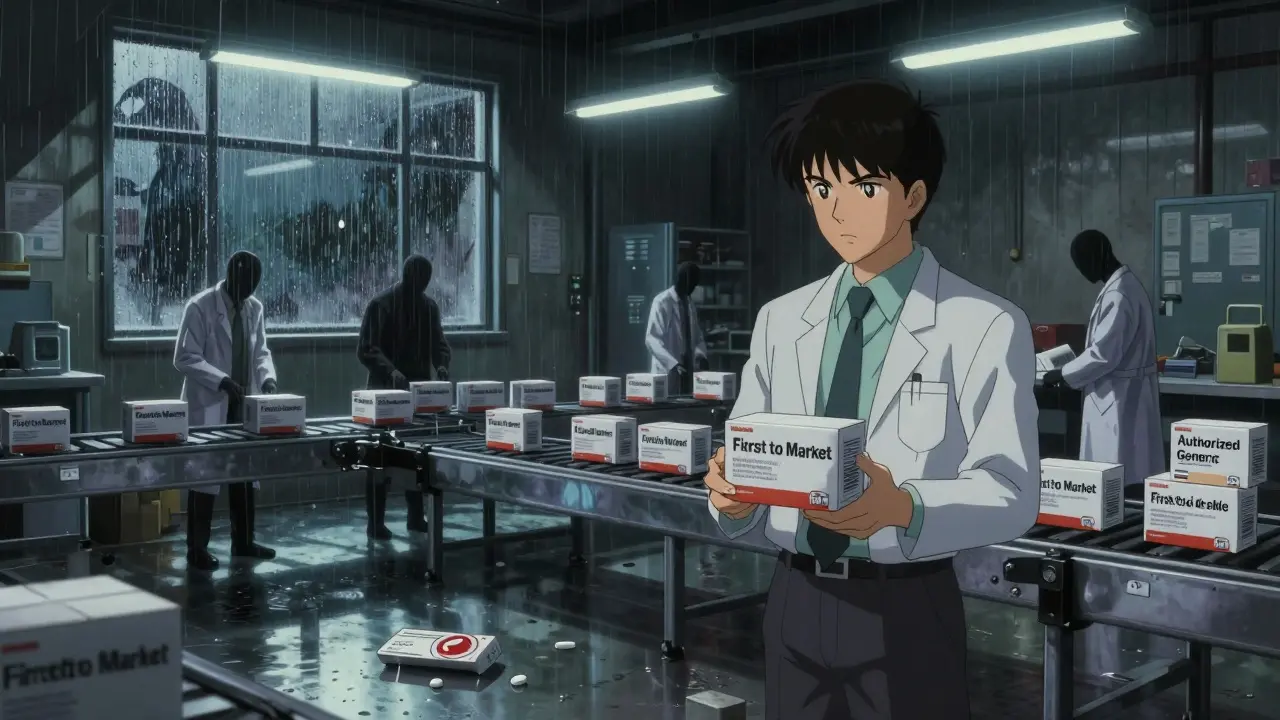
When a generic drug company challenges a patent on a brand-name medication, it risks millions in legal costs. But if it wins, it can get a 180-day exclusivity period - a legal shield that blocks other generics from entering the market. Sounds fair, right? Except here’s the twist: the brand-name company can still sell the exact same drug, just without its logo on the bottle. This is called an authorized generic, and it’s legal, common, and deeply controversial.
Under the Hatch-Waxman Act of 1984, Congress created the 180-day exclusivity rule to push generic manufacturers to take on risky patent lawsuits. The idea was simple: if you’re the first to challenge a patent and win, you get a head start. No other generic can launch for six months. That’s your reward. But over time, brand-name drugmakers figured out a loophole. They don’t have to wait. They can launch their own version of the generic - same active ingredient, same factory, same packaging - and sell it under a different label. No FDA review needed. No delay. Just like that, the exclusivity period starts to crumble.
How the 180-Day Exclusivity Rule Actually Works
To qualify for the 180-day exclusivity, a generic company must file what’s called a Paragraph IV certification. This means they’re saying, "This patent is either invalid or we don’t infringe it." They have to file this with their Abbreviated New Drug Application (ANDA) and notify the brand-name maker within 20 days. If the brand-name company sues, the FDA can’t approve the generic for up to 30 months - that’s the legal stay. But if the generic wins the lawsuit, or if the patent is found invalid, the exclusivity clock starts ticking.
The clock doesn’t start when the FDA approves the drug. It starts when the generic company actually ships the product to pharmacies. That’s a key detail. Many companies have lost their exclusivity because they thought approval meant they could start selling. They didn’t. The FDA’s 2017 guidance made it clear: no shipment, no exclusivity. And once the clock starts, no other generic can enter for 180 days. That’s the law.
But here’s where it gets messy. The law doesn’t say anything about the brand-name company. It doesn’t stop them from selling their own version. And they do - often. Between 2005 and 2015, about 60% of drugs with 180-day exclusivity saw an authorized generic launched during that window. That’s not rare. It’s standard.
Why Authorized Generics Are a Game-Changer
An authorized generic isn’t a copy. It’s the real thing. Same pill. Same manufacturer. Same batch. The only difference? No brand name. The brand-name company simply removes the logo and sells it to wholesalers at a lower price. It’s not a loophole - it’s built into the system. The FDA allows it. Courts have upheld it. And it’s devastating for the first generic.
Imagine you’re the first generic company. You spent $4 million on lawyers. You waited three years. You finally win. You launch. Your market share should hit 80%. But then the brand-name company drops its own generic version. Price drops. Sales split. Your market share falls to 50%. Revenue? Down 30-50%. That’s not a minor hit. That’s a financial gut punch.
Take Teva and Eli Lilly’s battle over Humalog. Teva won its patent challenge and got exclusivity. Lilly launched its authorized generic the same day. Teva lost an estimated $287 million in revenue. That’s not a guess. It’s in court filings. And Teva wasn’t alone. Between 2015 and 2020, first generic companies captured only 52% of the revenue they were expected to make. The rest? Gone to authorized generics.
The Legal Gray Zone
The law doesn’t forbid authorized generics. But it doesn’t encourage them either. There’s no statute saying, "You can do this." There’s also no statute saying, "You can’t." So it’s a legal gray zone - and the brand-name companies have exploited it.
Some argue it’s good for consumers. Lower prices. More competition. The FDA itself said in 2011 that prices are lower when authorized generics enter the market. A 2021 RAND study found prices dropped 15-25% when an authorized generic competed with the first generic. That’s real savings.
But here’s the problem: the whole point of the 180-day exclusivity was to incentivize patent challenges. If you can’t make money from winning, why bother? Smaller generic companies can’t afford $3 million lawsuits if they know the brand-name company will undercut them the moment they launch. A 2022 Drug Patent Watch report found that 78% of first applicants now negotiate contracts with brand-name companies to delay authorized generic launches. These are secret deals. Sometimes, the brand-name company agrees not to launch the authorized generic - in exchange for a cut of the first generic’s profits. That’s not competition. That’s collusion.
The Federal Trade Commission (FTC) has filed 15 antitrust lawsuits since 2010 over these practices. They say it’s anti-competitive. Brand-name companies say it’s legal. Courts keep siding with the brand-name side - because, technically, it is.
What’s Changing? Legislative Pushes and FDA Stance
The debate isn’t over. In 2023, Congress reintroduced the Preserve Access to Affordable Generics and Biosimilars Act. This bill would ban brand-name companies from launching authorized generics during the 180-day window. If it passes, the value of a successful patent challenge could jump by $150-$250 million per drug. That would bring more challengers into the game.
FDA Commissioner Robert Califf testified in March 2023 that the agency supports this change. He said the current system creates "unintended disincentives" for generic companies to take on patent battles. The FTC agrees. Their 2022 report says banning authorized generics during exclusivity would boost first generic revenues by 35% on average.
But the pharmaceutical industry, led by PhRMA, pushes back. They say consumers win with more options. And they’re not wrong. When an authorized generic enters, prices fall faster. Patients get cheaper drugs sooner. The trade-off? The incentive to challenge patents weakens.
Real-World Impact on Generic Companies
For small generic manufacturers, the 180-day exclusivity rule is a gamble. One mistake - misreading the trigger date, missing a filing deadline, failing to ship on time - and you lose everything. The FDA says 28% of first applicants between 2018 and 2022 lost part or all of their exclusivity due to procedural errors.
Larger companies hire teams just to manage this. Regulatory experts. Legal counsel. Commercial strategists. They spend $500,000 to $1 million just to make sure they don’t blow the exclusivity window. Smaller companies? They can’t afford that. So they avoid Paragraph IV challenges altogether. That’s bad for patients. Fewer challenges mean fewer generics. Slower price drops.
And it’s not just about money. It’s about timing. If you launch too early - before FDA approval - you lose exclusivity. If you wait too long, someone else might beat you to market. The whole system is a minefield.
The Bigger Picture
The U.S. generic drug market is worth $65 billion. It fills 90% of prescriptions but costs only 23% of total drug spending. That’s because generics are cheap. And the 180-day exclusivity rule was meant to keep them coming. But authorized generics have turned the rule into a double-edged sword. It still drives innovation - but only for the biggest players. For everyone else? It’s too risky.
Since 1984, this system has saved $2.2 trillion in healthcare costs. That’s huge. But if the incentive fades, fewer companies will challenge patents. Fewer challenges mean fewer generics. And that means higher prices in the long run.
The system was built to balance innovation and access. Today, it’s tilted. The brand-name companies have the upper hand. The generic companies are left holding the bag - and the legal bills.
What is an authorized generic?
An authorized generic is a brand-name drug sold without the brand name on the label. It’s made by the same company, in the same facility, with the same ingredients. The only difference is packaging and pricing. It’s not a copy - it’s the original drug rebranded as a generic.
Can the brand-name company launch an authorized generic before the 180-day exclusivity ends?
Yes. There is no legal barrier preventing a brand-name manufacturer from launching an authorized generic at any time - even before the first generic enters the market. The 180-day exclusivity rule only blocks other generic companies from launching, not the original brand.
Why do generic companies still challenge patents if authorized generics can undercut them?
They still do - but only if they can negotiate deals. Many generic companies now include clauses in patent settlement agreements that require the brand-name company to delay or block authorized generic entry. Without that guarantee, the financial risk is too high. Smaller companies often avoid challenges entirely.
How does the FDA define "first commercial marketing"?
The FDA defines "first commercial marketing" as the first time the generic drug is shipped to customers after receiving FDA approval. Approval alone doesn’t trigger the 180-day clock. You must actually sell and deliver the product. Many companies have lost exclusivity because they confused approval with launch.
Is there legislation to stop authorized generics during exclusivity?
Yes. The Preserve Access to Affordable Generics and Biosimilars Act (S. 1665/H.R. 3928), reintroduced in 2023, would ban brand-name companies from launching authorized generics during the 180-day exclusivity period. It has not yet passed, but the FDA and FTC both support it.
What Comes Next?
The fight isn’t going away. The 180-day exclusivity rule is still the backbone of generic drug competition. But without reform, it’s losing its power. If Congress doesn’t act, more patent challenges will vanish. More patients will pay higher prices. And the system meant to save money will end up costing more.
For now, the rules are clear: if you’re a generic company, you’re on your own. If you’re a brand-name company, you’re playing by the rules - even if those rules favor you. And if you’re a patient? You’re caught in the middle - hoping the system still works the way it was supposed to.
10 Comments
Patrick Jarillon February 7 2026
Let me break this down for you people who think the FDA gives a damn about patients
They don't. This whole system is a front. The real players? Big Pharma and the DOJ. They're in bed together. Authorized generics? That's not a loophole - it's the whole damn plan. The government lets them do it because they want you to think competition exists. But it's all theater. The same factory. The same pill. The same price gouging under a different label. Wake up. This isn't capitalism. It's state-sponsored fraud.
And don't even get me started on the FTC. They file lawsuits like it's a hobby. Meanwhile, the brand names laugh all the way to the bank. They're not breaking the law - they're rewriting it. And you're paying for it. Every. Single. Month.
Gouris Patnaik February 8 2026
India understands this better than America ever will. In India, we don't play these games. We make generics. We make them cheap. We make them accessible. No drama. No legal chess. Just medicine for the people. The U.S. system is a circus. A theater of greed wrapped in legal jargon. You think patents protect innovation? No. They protect profits. And authorized generics? Just another way for Western corporations to milk the system while pretending to be fair. We don't need your loopholes. We need your humility.
Amit Jain February 8 2026
Bro this whole thing is rigged and everyone knows it
First generic spends 4 million on lawyers only to get owned by the same company that made the original drug? That's not innovation. That's a trap. The brand-name companies are literally playing 4D chess while the generics are stuck playing checkers. And the FDA? They're just watching like it's a reality show. I'm telling you - if you're a small generic company and you file a Paragraph IV, you're not a pioneer. You're a sacrificial lamb. They want you to fight. They want you to lose. Then they swoop in with their own version and call it "competition." Bullshit.
Sarah B February 9 2026
Authorized generics are fine. Lower prices for patients. End of story. Why are you making this so complicated? The system works. Stop crying about your lost profits. If you can't compete then don't enter the game. Patients win. That's what matters. Not your bank account.
Jesse Lord February 9 2026
I've been following this for years and honestly I think most people miss the point
The real tragedy isn't that big pharma uses authorized generics - it's that the system was designed to help small companies but now only the big ones can survive it. The legal costs, the timing traps, the FDA's confusing rules - it's all stacked against the underdog. And yeah, maybe patients get cheaper drugs faster but at what cost? We're killing the next generation of generic innovators. We need to fix this before it's too late. It's not about who wins. It's about whether the system still has any soul left.
Paula Sa February 11 2026
What I find really interesting is how the incentives got twisted over time
Originally the 180-day exclusivity was meant to be a reward - a way to say thank you for taking a huge risk. But now it's become a liability. Why would anyone risk millions if the moment they win, the original company just drops their own version? It's like being told you get a prize for running a marathon... but then the guy who organized the race runs the same race right behind you with a faster pair of shoes. The system needs to be reset. Not banned. Not overhauled. Just... fixed. So the people who actually do the hard work get the benefit. That's not radical. That's just fair.
Mary Carroll Allen February 13 2026
okay so i just read this whole thing and i have to say i never realized how messed up this is
like i thought generics were supposed to be the underdogs fighting big pharma but now it turns out big pharma is just... pretending to be the generic? like theyre the same company?? the same pill?? the same factory?? i feel like my brain just broke
and then they say "oh but prices go down" yeah but only because theyre playing both sides of the game?? and the real winners are the ones with lawyers and lobbyists?? this is not capitalism this is a scam wrapped in a legal document
and why is no one talking about this more??
Joey Gianvincenzi February 13 2026
It is imperative to underscore that the current regulatory architecture governing pharmaceutical competition in the United States is not merely flawed - it is structurally compromised. The emergence of authorized generics as a market mechanism, while ostensibly consonant with statutory provisions, fundamentally undermines the foundational intent of the Hatch-Waxman Act. To permit the originator entity to deploy a virtually identical product under a different nomenclature - devoid of brand equity yet retaining full manufacturing control - constitutes a pernicious distortion of competitive equilibrium. This is not market innovation. It is regulatory capture cloaked in semantic ambiguity. The Federal Trade Commission's advocacy for legislative intervention is not merely prudent - it is morally exigent. The American public deserves a system that incentivizes challenge, not collusion.
Tola Adedipe February 13 2026
Canada has seen this play out too and we just said no
We don't let brand companies launch authorized generics during exclusivity. Period. It's in our law. And guess what? More generics still got approved. More competition. Lower prices. No one's crying about it. The U.S. could fix this tomorrow if it wanted to. But it doesn't want to. Because the money's too good. And the lobbyists are too loud. We don't need your legal gymnastics. We need real competition. And we got it. You just need the will.
Eric Knobelspiesse February 15 2026
so here's the thing no one is saying
the 180 day exclusivity was never meant to be a profit engine
it was meant to be a catalyst
but now its just a lottery ticket that only the big players can afford to buy
and the authorized generic? its not even a loophole
its the whole damn game
the brand companies dont even need to fight anymore
they just wait for someone else to do the work then swoop in
and the FDA? they just nod and smile
and the patients? they get cheaper drugs but the system is rotting from the inside
and no one wants to fix it because its too profitable
and thats the saddest part