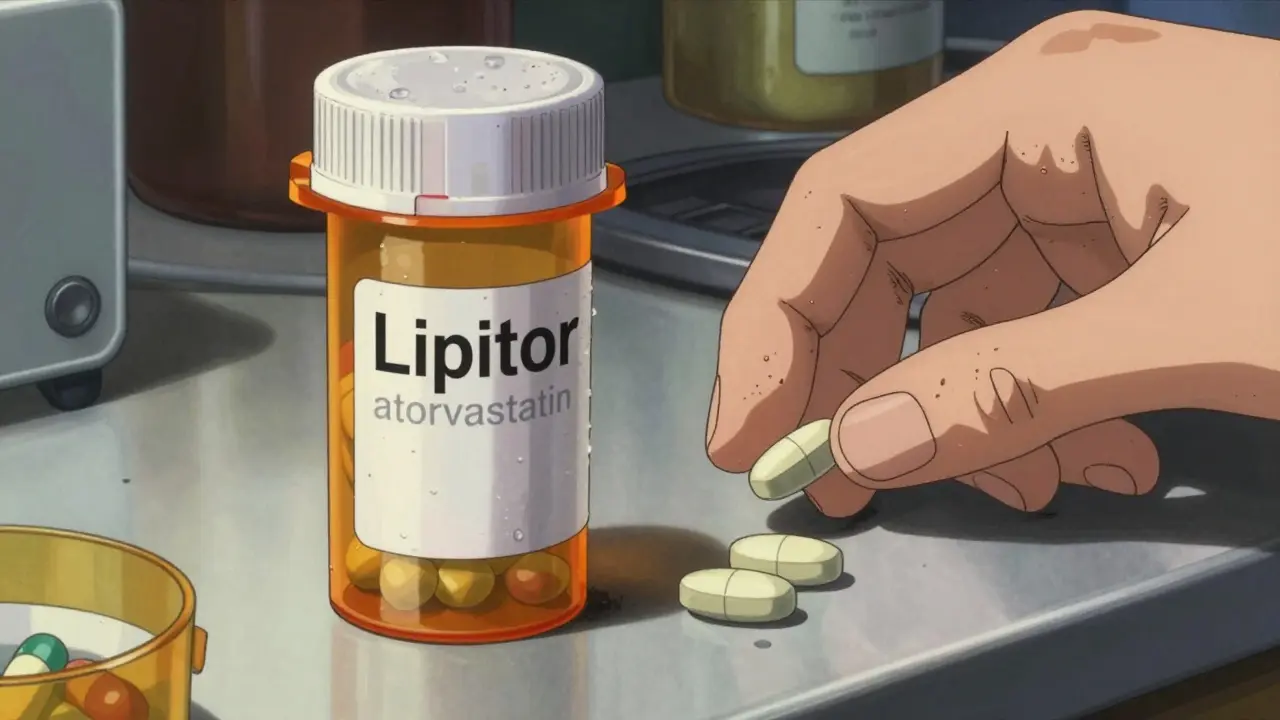
Ever opened your prescription bottle and wondered why the pill looks totally different from last time? Or seen two names on the label and gotten confused? You’re not alone. Most people don’t realize that the name on the front of the bottle isn’t the only name that matters. There’s a second name, usually smaller and tucked underneath - and it’s the one that actually tells you what’s inside your medicine.
What’s the Difference Between Generic and Brand Names?
Every prescription drug has two names: a brand name and a generic name. The brand name is the trademark created by the company that originally developed the drug - like Prilosec or Lipitor. The generic name is the chemical identity of the active ingredient - like omeprazole or atorvastatin. These names point to the exact same medicine. One is a brand, the other is the science.
The FDA requires that generic drugs contain the same active ingredient, in the same amount, and work the same way in your body as the brand-name version. That means if your doctor prescribes Lipitor (atorvastatin), and you get the generic, you’re getting the same molecule that lowers cholesterol. The difference? Price. A brand-name Lipitor might cost $300 a month. The generic? Around $4.
Why Do They Look Different?
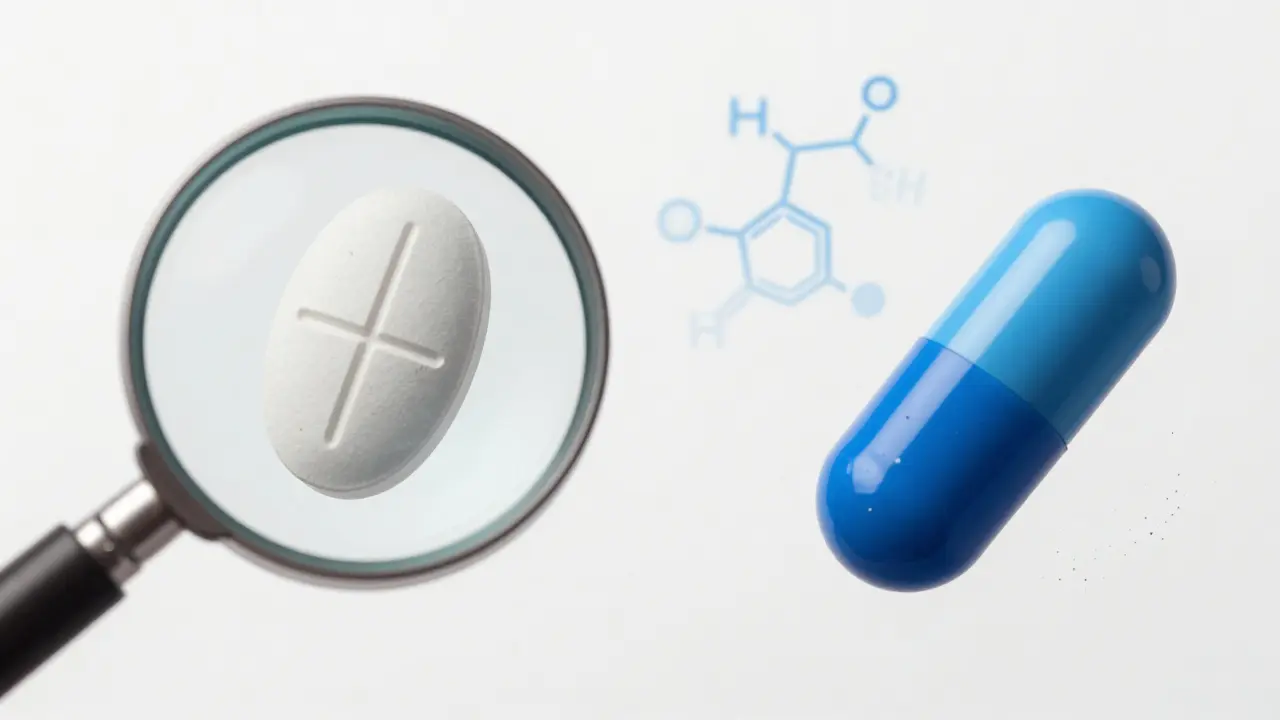
If the medicine is the same, why do generic pills look different? It’s because of trademark law. The original manufacturer owns the look of their pill - the color, shape, and imprint. Generic manufacturers can’t copy that exactly. So they make their version a different shade of blue, a different shape, or with a different marking. This isn’t a trick - it’s the law.
But here’s the catch: those differences can cause confusion. A 2022 CVS Health survey found that 24% of patients reported mixing up pills because they looked different from what they remembered. One person might switch from a white oval pill to a blue capsule and think, “This isn’t the same.” But unless your doctor specifically said “dispense as written,” the pharmacy is legally allowed to substitute the generic - and it’s just as effective.
How Do You Know Which Is Which on the Label?
Prescription labels follow a standard format. The brand name usually appears first, in larger text. Below it, in smaller font, is the generic name. For example:
- Brand Name: Nexium
- Generic Name: esomeprazole
By law, pharmacies in 41 U.S. states must include both names on the label. The National Association of Boards of Pharmacy says 92% of all prescription bottles follow this pattern. If you don’t see both, ask your pharmacist. You have the right to know what you’re taking.
Are Generics Really Just as Good?
Yes - and the science backs it up. The FDA requires generics to prove bioequivalence. That means they must deliver the same amount of medicine into your bloodstream within a very tight range - 80% to 125% of the brand-name drug’s effect. This isn’t a guess. It’s tested in clinical trials using blood samples from volunteers.
Over 90% of all prescriptions filled in the U.S. are for generics, according to University Hospitals’ 2022 analysis. And they’ve saved Americans over $1.6 trillion since 2007. That’s not just a savings - it’s a lifeline for people on fixed incomes or without good insurance.
Even more surprising: about half of all generic drugs are made by the same companies that make the brand-name versions. Pfizer, Merck, and other big names often produce generics under different labels. So when you take a generic, you might be getting the exact same factory product - just cheaper.
When Might You Need the Brand Name?
For most people, generics are perfect. But there’s a small group where switching can be risky: people taking drugs with a narrow therapeutic index (NTI). These are medications where even tiny changes in blood levels can cause serious side effects or make the drug stop working.
Examples include warfarin (a blood thinner), levothyroxine (for thyroid), and some seizure medications. While the FDA says generics are still approved as equivalent, some doctors prefer to stick with the brand name for these. Why? Because the margin for error is razor-thin. A 2022 BeMedWise report notes that while most NTI drugs are safe to switch, it’s best to talk to your doctor before changing.
And if you’ve had a bad experience? Say you switched to a generic and felt more tired, or got a rash - don’t assume it’s “all in your head.” Sometimes, it’s not the active ingredient. It’s the inactive ones - the fillers, dyes, or coatings. A person with a corn allergy might react to a generic version that uses corn starch, while the brand used potato starch. These differences are rare, but real. If something feels off, talk to your pharmacist. They can check the inactive ingredients and suggest alternatives.
Why Do Generics Cost So Much Less?
Brand-name drugs cost so much because the company had to pay for years of research, clinical trials, and marketing. The average cost to bring a new drug to market? Over $2.6 billion, according to Tufts Center for the Study of Drug Development.
Generic manufacturers don’t have to do that. They only need to prove their version works the same way - not that it cures the disease from scratch. That cuts development costs by over 90%. No marketing campaigns. No patent protection. Just a clean, efficient process that passes FDA standards.
That’s why generics are cheaper. Not because they’re lower quality. Because they don’t carry the weight of innovation costs.
What’s Changing in 2025 and Beyond?
The landscape is shifting. More biologic drugs - complex medicines made from living cells - are losing patent protection. These used to be too expensive to copy. But now, biosimilars are entering the market. They’re not exact copies like traditional generics, but they’re close enough to offer savings of 15-30%. Expect more of these to appear on your prescription labels in the next few years.
Also, Medicare Part D is changing. Starting in 2025, seniors won’t pay more than $2,000 a year for all their drugs. That’s going to push even more people toward generics, because they’re the easiest way to stay under that cap.
But there’s a warning: 80% of the raw ingredients for generic drugs come from just two countries - China and India. Supply chain issues during the pandemic showed how fragile this system is. If a factory shuts down overseas, you might see delays or shortages. The FDA is working on faster approvals and better oversight, but it’s a global problem.
What Should You Do?
- Always check your prescription label for both names - brand and generic.
- If you’re unsure if your pill changed, ask your pharmacist. They can tell you if it’s the same medicine, just made differently.
- Don’t assume a different-looking pill is weaker. It’s likely the same.
- If you feel different after switching, talk to your doctor or pharmacist. It might be an inactive ingredient, not the active one.
- Ask if your insurance requires a generic. If they do, you’re saving money - and you’re still getting the same treatment.
Medicine isn’t about labels. It’s about what’s inside. And when it comes to generics, what’s inside is exactly what your doctor prescribed - just at a price that actually fits your life.
Are generic drugs as effective as brand-name drugs?
Yes. The FDA requires generic drugs to have the same active ingredient, strength, dosage form, and route of administration as the brand-name drug. They must also prove they work the same way in the body through bioequivalence testing. Over 90% of prescriptions in the U.S. are for generics, and they’ve saved the healthcare system over $1.6 trillion since 2007.
Why do generic pills look different from brand-name pills?
Trademark laws prevent generic manufacturers from copying the exact color, shape, or imprint of brand-name pills. This ensures consumers can tell them apart. But these visual differences don’t affect how the medicine works. The active ingredient is identical - only the inactive ingredients (like dyes or fillers) may vary.
Can I ask my pharmacist to give me the brand-name drug instead of the generic?
Yes, but you may have to pay more. Pharmacists are allowed to substitute generics unless your doctor writes “dispense as written” or “no substitution” on the prescription. If you prefer the brand name, you can request it - but your insurance may not cover the full cost, and you’ll likely pay out-of-pocket for the difference.
Are there any drugs where generics aren’t recommended?
For most drugs, generics are perfectly safe. But for medications with a narrow therapeutic index - like warfarin, levothyroxine, or certain anti-seizure drugs - even small differences in blood levels can matter. While generics are still approved as equivalent, some doctors prefer to stick with the brand name for these. Always talk to your provider before switching.
Why do some people say generics don’t work as well for them?
Sometimes, it’s not the active ingredient - it’s the inactive ones. Fillers, dyes, or coatings in generics can affect how fast the drug is absorbed, especially in people with sensitivities. For example, someone allergic to corn starch might react to a generic that uses it, while the brand used potato starch. These cases are rare, but real. If you notice changes after switching, talk to your pharmacist. They can check the ingredients and help you find a match.
How do I know if my prescription label includes both names?
By law, most pharmacies in the U.S. include both the brand name and generic name on the label. The brand name usually appears in larger text, and the generic name is written below in smaller font. If you don’t see both, ask your pharmacist. In 41 states, they’re required to provide both names upon request.
12 Comments
Laura Gabel March 20 2026
I got the generic version of my blood pressure med and it felt like someone swapped my pills for placebo. Turned out the filler was corn starch and I’m allergic. Pharmacist didn’t tell me. Now I ask for the brand. Worth the extra $20.
Jeremy Van Veelen March 20 2026
Oh honey, you think this is groundbreaking? I’ve been lecturing my undergrads on bioequivalence since 2012. The FDA’s 80-125% window is a joke. It’s not science-it’s a compromise between capitalism and public health. And don’t get me started on how the same companies make both. The system is rigged, and you’re just now noticing?
jared baker March 21 2026
Same medicine. Different look. Cheaper price. That’s it.
Kal Lambert March 22 2026
If you're worried about the pill looking different, check the imprint code. It's on the pill itself. That's the real ID. Generic manufacturers have to put it there. Same active ingredient, same code, same effect. No magic.
gemeika hernandez March 23 2026
I switched to generic levothyroxine and gained 12 pounds in three weeks. My doctor said it was 'just metabolism' but I know better. They're using fillers from China. I'm going back to Synthroid. No way I'm letting Big Pharma poison me for savings.
Nilesh Khedekar March 24 2026
you know what they dont tell u? most generics are made in india and china and the factories are dirty. my cousin works at one and he says they reuse water and dont test batches. they just slap a label on it and ship it. we're all guinea pigs now. #fakepharma
jerome Reverdy March 25 2026
I used to be skeptical too until I worked in a pharmacy. The bioequivalence data is solid. What trips people up? Inactive ingredients. One guy had a histamine reaction to a dye in the generic version of his antidepressant. Switched back, problem gone. It’s not about efficacy-it’s about tolerability. Always ask for the pill’s inactive ingredients sheet. Most pharmacists have it. Just say 'I need the excipient list.'
Gaurav Kumar March 26 2026
America thinks generics are 'inferior' because they don't understand that innovation is a business model, not a moral virtue. In India, we’ve been using generics for decades. We don't pay $300 for a pill that does the same thing as a $4 one. Our healthcare system doesn't bankrupt people. You want to talk about 'quality'? Look at your bank account after a hospital visit. 🇮🇳💪
David Robinson March 27 2026
I’ve been reading this whole thing and honestly? You're missing the point. It’s not about whether generics work. It’s about how pharmacies are legally allowed to switch them without telling you. I had a patient who had a seizure because they switched from one generic to another without telling her. The active ingredient is the same, but the absorption rate? Totally different. And now she’s suing. This isn’t a public service article. It’s a corporate PR piece. The system is designed to hide the risk.
Manish Singh March 28 2026
In India, we call brand-name drugs 'luxury pills'. Most people can't afford them. Generics are the backbone. My uncle takes generic atorvastatin and his cholesterol is better than my dad's Lipitor. The science doesn't lie. Also, the same factories make both. It's just a different box. Stop fearing what's cheap. Fear what's unaffordable.
Aileen Nasywa Shabira March 30 2026
Oh wow. So you’re telling me the same company that charges $300 for a pill suddenly makes the exact same pill for $4? And we’re supposed to believe they’re not cutting corners? 🤡 Next you’ll say the moon landing was real. I’ve seen the inside of a generic pill factory. It’s not a lab. It’s a warehouse with a stamp. Don’t be a sheep.
Nicole Blain March 31 2026
I just got my refill and the pill was blue instead of white 😳 I almost called my doctor in tears. Then I looked up the imprint code and it matched. Phew. 🤫💊 #genericswork #thankyoupharmacist