
After a colonoscopy finds and removes polyps, many people assume they’re in the clear-until they get a letter saying they need another one in just a few years. It’s confusing. Why do some people need to come back in 3 years and others in 10? What even counts as a high-risk polyp? The answer isn’t one-size-fits-all. It depends on the polyp type, size, number, and how cleanly it was removed.
What Polyp Characteristics Matter Most?
Not all polyps are the same. The big three types you’ll hear about are adenomas, serrated polyps, and hyperplastic polyps. Only adenomas and certain serrated polyps are linked to colon cancer. Hyperplastic polyps under 10 mm are usually harmless and don’t change your risk much.
Adenomas are the most common precancerous growths. If you have one or two that are smaller than 10 mm, your risk of developing colon cancer in the next decade is almost the same as someone with a completely normal colon. That’s why the 2020 US Multi-Society Task Force updated their guidelines to stretch the follow-up to 7-10 years. Before that, it was 5 years. The change wasn’t arbitrary-it came from tracking tens of thousands of patients over time. Studies show 99.3% of people with 1-2 small adenomas didn’t develop cancer in 10 years.
But if your adenoma is 10 mm or bigger, or if it has villous features or high-grade dysplasia, that’s a red flag. These are high-risk features. They mean the cells are changing faster, and cancer could develop sooner. That’s why your next colonoscopy is due in 3 years.
How Many Polyps Change the Game?
Number matters. One or two small adenomas? 7-10 years. Three or four? Now you’re in the 3-5 year window. Five or more? Back in 3 years, no matter the size. This isn’t about panic-it’s about probability. More polyps mean more places cancer could start. It’s like checking a house for leaks: one leak? Fix it and check again in a few years. Ten leaks? You’re going back next month.
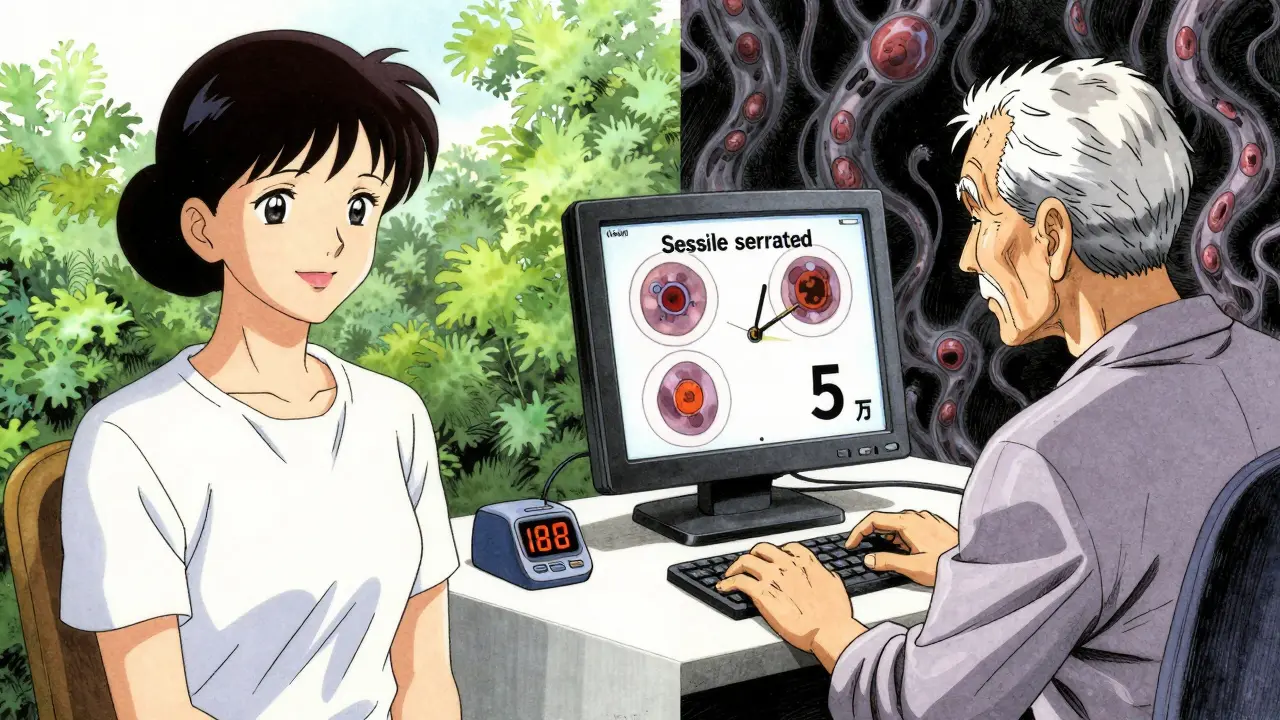
And then there are serrated polyps. These are trickier. Sessile serrated lesions (SSLs) are the real concern. Even if they’re small-under 10 mm-having three or four means you need a repeat colonoscopy in 3-5 years. Five or more? 3 years. Why? Because SSLs can hide in plain sight. They’re flat, pale, and often missed on first pass. If they’re not fully removed, they can turn into cancer faster than adenomas.
Here’s a real-world example: a 58-year-old woman has a colonoscopy and two 6 mm adenomas removed. Her doctor says, “Come back in 10 years.” She’s relieved. Another patient, 62, has three 8 mm SSLs. He’s told to return in 5 years. Same age, same procedure, different timelines. That’s because of the polyp type, not age or symptoms.
What If the Polyp Wasn’t Removed Completely?
Piecemeal resection-when a big polyp has to be cut into pieces-is a big deal. If a polyp is 20 mm or larger and removed in pieces, your next colonoscopy is due in 6 months. Why? Because leftover tissue can regrow. Even a tiny bit of abnormal tissue left behind can become a new problem. That’s not a suggestion-it’s a requirement. Missing this window increases your risk of cancer.
Some European guidelines say 3-6 months, but most US, Japanese, and Korean guidelines stick with 6 months as the standard. The key is consistency. If your doctor says “come back in 6 months,” don’t wait until 8. That 2-month delay could mean the difference between catching a recurrence early or letting it progress.
What About Serrated Polyposis Syndrome?
This is rare, but serious. If you have more than 20 serrated polyps total, with at least 5 being 10 mm or larger, you’re diagnosed with serrated polyposis syndrome (SPS). This isn’t just a high-risk category-it’s a high-risk lifestyle. Annual colonoscopies are the rule. Some guidelines say every 1-2 years until age 75, but if you go 2 years without new polyps, you might stretch it to every 2 years. Still, you’re not off the hook. This condition demands lifelong monitoring.
Why Do So Many People Get Follow-Ups Too Soon?
Here’s the uncomfortable truth: most people get colonoscopies way too early. A 2020 study at a Veterans Affairs hospital found that 81.4% of doctors still told patients with 1-2 small adenomas to come back in 5 years-even though the official guideline had been updated to 7-10 years. Why? Fear. Fear of missing something. Fear of being sued. Fear of patients complaining.
But over-testing is a problem too. It’s expensive. It’s inconvenient. It exposes you to unnecessary sedation and bowel prep risks. And it clogs up the system. In 2022, over 15 million colonoscopies were done in the US. If even 20% of those were done too early, that’s 3 million unnecessary procedures. That’s 3 million people who could’ve waited, saved money, and avoided discomfort.
Doctors aren’t bad. They’re just overwhelmed. A 2022 survey of 347 gastroenterologists found only 37% could correctly identify all the USMSTF risk categories. And when it came to serrated polyps? Only 28.5% got it right. That’s not a failure of patients-it’s a failure of system support.

Tools That Actually Help
There are tools now that make this easier. Polyp.app, developed by Massachusetts General Hospital, lets you input your polyp details and instantly get the right interval. It’s used by over 12,000 clinicians. Epic and Cerner, the big electronic health record systems, now have built-in prompts that suggest the correct follow-up based on what’s documented in your procedure note.
But these tools only work if the doctor enters the right data. If they write “adenoma, small” without specifying size or number, the system can’t help. That’s why it’s smart to ask for a written summary after your colonoscopy. Don’t just take a verbal note. Get the details: number, size, type, resection method. Keep it. Show it to your next doctor.
What’s Coming Next?
The future of colonoscopy surveillance isn’t just about counting polyps. Researchers are testing blood and stool tests that look for DNA methylation patterns-biological markers that tell you if you’re at high risk, even if your colon looks clean. Trials like NCT04567821 are already underway. In 5-10 years, your follow-up might be based on a simple blood test, not another scope.
For now, though, the rules are clear: know your polyp type, know your numbers, know your size. Don’t guess. Don’t rely on memory. If your doctor says “come back in 5 years,” ask: “Is that based on the 2020 USMSTF guidelines? I have 1-2 small adenomas.” You might be surprised by the answer.
When to Worry
You don’t need to panic after every polyp. But you do need to be informed. If you’re told to return in 3 years, make sure you understand why. If you’re told to wait 10 years, ask if your polyps were low-risk. If you had a large polyp removed in pieces, don’t delay your 6-month follow-up. And if your doctor doesn’t mention the exact polyp characteristics, ask for them. Your life depends on it.
How long should I wait for my next colonoscopy after having 1-2 small adenomas removed?
According to the 2020 US Multi-Society Task Force guidelines, you should wait 7-10 years for your next colonoscopy if you had 1-2 adenomas smaller than 10 mm, and they were completely removed. This is a change from the old 5-year rule, based on long-term studies showing cancer risk is nearly the same as someone with a normal colon. If your polyps were larger than 10 mm or had high-risk features, the interval drops to 3 years.
What if I had serrated polyps instead of adenomas?
It depends on the type and number. Sessile serrated lesions (SSLs) under 10 mm are treated differently than adenomas. If you had 1-2 SSLs, your next colonoscopy is due in 5-10 years. Three or four? 3-5 years. Five or more? Return in 3 years. Hyperplastic polyps under 10 mm usually don’t require early follow-up, but if they’re large (10 mm or more) or if there’s uncertainty about whether they’re SSLs, your doctor may recommend 3-5 years.
Why do some doctors still say 5 years for low-risk polyps?
Many doctors are still using the old 2006 guidelines or are cautious due to fear of missing something. A 2020 study found 81.4% of US gastroenterologists recommended 5-year intervals even after the 2020 update. It’s not always negligence-it’s lack of awareness, system gaps, or medicolegal concerns. Ask your doctor which guidelines they’re following. If they’re unsure, request a written summary of your polyp findings.
What happens if I miss my follow-up colonoscopy?
Missing your recommended interval increases your risk of developing colorectal cancer. Studies show that people who get their follow-up on time reduce their cancer risk by 43-48%. The biggest danger isn’t the polyp turning cancerous-it’s that a new one develops unnoticed. If you miss your window, schedule the colonoscopy as soon as possible. Don’t wait until symptoms appear. Early detection saves lives.
Do I need a colonoscopy if I had only hyperplastic polyps?
If you had only hyperplastic polyps smaller than 10 mm and no other risk factors, you likely don’t need a follow-up colonoscopy any sooner than the general population-usually 10 years. But if you had large hyperplastic polyps (10 mm or more), or if there’s uncertainty about whether they were actually sessile serrated lesions, your doctor may recommend 3-5 years. Always confirm the exact pathology report.
Can I skip colonoscopy if I have a negative stool test after polyp removal?
No. Stool tests like FIT or Cologuard are good for screening, but they’re not substitutes for surveillance after polyp removal. Even if your stool test is negative, you still need a colonoscopy at the recommended interval. Polyps can be missed by stool tests, and surveillance is about visual confirmation and removal-not just detection.
Is it safe to wait 10 years if I have one small adenoma?
Yes. Multiple large studies show that people with one small adenoma (≤10 mm) have a 99.3% chance of not developing colorectal cancer over 10 years-almost identical to those with a normal colonoscopy. Waiting 10 years is not only safe, it’s the recommended standard under current guidelines. The goal is to reduce unnecessary procedures without compromising safety.
13 Comments
Sally Denham-Vaughan January 1 2026
Man, I just got my results back and they said 10 years. I was expecting 5, so I almost cried. My mom had colon cancer, so I was terrified. But now I’m like… maybe I can actually take a breath? Thanks for this post, it’s the first time I felt like someone actually explained it without making me feel dumb.
Bill Medley January 2 2026
The 2020 USMSTF guidelines are evidence-based and should be followed without deviation.
Ann Romine January 2 2026
In Nigeria, we don’t even have access to colonoscopies unless you’re wealthy. I’m glad people here are getting proper follow-ups, but I wonder how many others are just… not getting anything at all.
Donna Peplinskie January 4 2026
Wow… I didn’t realize how much detail mattered-like, the size, the type, whether it was removed in pieces… I just thought ‘polyp = bad’ and assumed all follow-ups were the same. I’m going to print this out and take it to my next appointment. I’ve been so overwhelmed, but this actually makes sense now. Thank you.
Andy Heinlein January 5 2026
10 years?! I’m gonna celebrate with tacos. No prep, no sedation, no stress. I’m gonna live my best life until then. Also, if you’re still getting 5-year reminders, tell your doc to update their software. It’s 2025, not 2015 lol
Todd Nickel January 6 2026
It’s fascinating how the shift from 5 to 7–10 years for low-risk adenomas reflects a broader paradigm in preventive medicine: moving away from reactive surveillance toward risk-stratified, data-driven intervals. The 99.3% non-cancer rate over a decade is statistically robust, and the cost-benefit analysis clearly favors extended intervals, especially when considering the cumulative risks of repeated bowel preps, sedation complications, and healthcare system strain. Yet, the persistence of outdated protocols suggests a cognitive dissonance between evidence and practice, possibly rooted in risk-averse clinician behavior, lack of EHR integration, or patient anxiety perpetuated by misinformation. The real challenge isn’t the science-it’s the implementation.
Austin Mac-Anabraba January 6 2026
Of course they extended the timeline. Big Pharma doesn’t want you getting colonoscopies too often-it cuts into their stool test profits. And don’t get me started on how the AMA and GI societies are in bed with Epic and Cerner. They push these ‘guidelines’ so hospitals can bill more for ‘advanced diagnostics.’ You think your 10-year window is safe? Wait until you’re 65 and they tell you your ‘low-risk’ polyp was actually a stealth cancer precursor. They’ll say you ‘missed your window.’
Phoebe McKenzie January 7 2026
THIS IS A SCAM. 10 YEARS?! You think they’re being careful? They’re cutting corners. My cousin got a 10-year notice and died of colon cancer at 59. They didn’t even find the tumor until it was stage 4. This isn’t ‘evidence-based’-it’s corporate greed. They want you to think you’re safe so you don’t complain when you’re dying. Wake up. Get another scope in 2 years. I’m not kidding. I’m not even scared to say it.
Stephen Gikuma January 8 2026
They’re lying to you. The real reason they’re stretching out the timelines is because the government doesn’t want to pay for all those colonoscopies. You think they care if you live? No. They care about the budget. And now they’ve got you believing you’re ‘low-risk’ so you don’t demand more tests. Meanwhile, the CDC’s getting paid to push these ‘guidelines.’ I’ve seen the documents. It’s all coded. Don’t trust the system. Get a second opinion. And if you’re in the US, you’re already being played.
Bobby Collins January 8 2026
wait so if i had 3 polyps but they were tiny… am i still supposed to go back in 3 years?? i thought i was fine?? 😳
Layla Anna January 9 2026
thank you for this!! i was so confused after my colonoscopy… now i know why they said 5 years for my sister but 10 for me 😊 we both had 1 polyp but mine was smaller!! i’ll print this and show my doc next time!!
Heather Josey January 10 2026
Thank you for this comprehensive and clinically accurate breakdown. It is imperative that patients are empowered with precise, guideline-aligned information. The variability in clinical practice underscores a critical gap in provider education and documentation integrity. I strongly encourage all individuals to request a written pathology summary and verify that polyp characteristics are explicitly recorded. This is not merely a recommendation-it is a vital component of patient safety and continuity of care.
Olukayode Oguntulu January 11 2026
Let’s be real-this entire framework is a neo-liberal construct designed to depoliticize bodily autonomy under the guise of ‘evidence.’ The polyp taxonomy is a colonial epistemology imposed by Western gastroenterology hegemony. In the Global South, we don’t need your 2020 USMSTF guidelines-we need decolonized diagnostics, community-led surveillance, and radical access to endoscopic infrastructure. Your ‘risk stratification’ is just a sanitized term for medical apartheid. And don’t get me started on how Polyp.app is just another Silicon Valley surveillance tool disguised as ‘innovation.’